
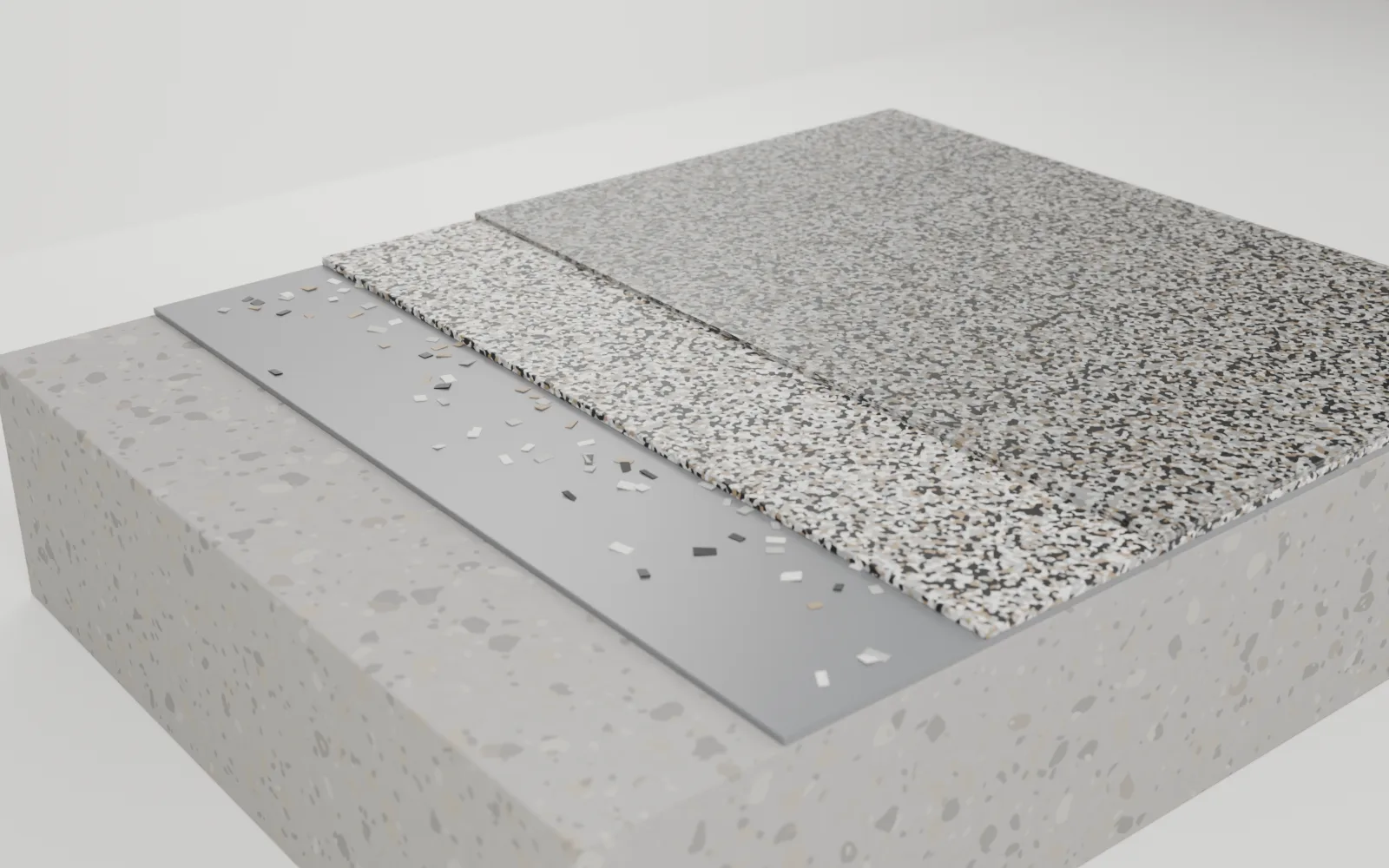
Epoxy, polyurea and polyaspartic all make a hard, glossy garage floor, and on the day they're installed they can look alike. The differences show up later: how long the car sits outside, what the strip by the door looks like after a few summers, and what happens where hot tires park. Here's how they compare on a floor that sees Wisconsin winters. We install polyurea and polyaspartic, not epoxy, so read this knowing which side we're on.
Side by side
Same flake colors, same square footage, and you're parking on it in a day or two instead of a week. The full comparison →
| Epoxy | Polyaspartic / polyurea | |
|---|---|---|
| Bond to concrete | Strong, penetrates well | Strong on properly ground concrete |
| Sunlight (UV) | Yellows over time | UV stable, stays clear |
| Cure speed | Slow: often a day or more per coat | Fast: recoat in hours |
| Typical install | Often 2–3 days | Usually 1 day for a one- or two-car garage |
| Before you park | Up to about a week | About 24–48 hours |
| Cold-weather install | Slows a lot in the cold | Cures at lower temperatures |
| Flexibility | Hard and more brittle | Tougher, more flexible |
| Hot-tire pickup | A risk with thin coats | Better resistance |
| Moisture coming up through the slab | Can push the coating loose; test first | Can push the coating loose; test first |
| Installed cost (national) | About $4–10 per sq ft | Polyurea about $5–10, polyaspartic about $5–12 per sq ft |
| Expected life in a home garage | Varies widely with the product and thickness | 10–20+ years when professionally installed |
Cure time and getting the garage back
This is the difference you feel first. Epoxy cures slowly, often a day or more per coat, so an epoxy floor is often a two- or three-day install, and it can need up to about a week before a car goes back on it. Polyaspartic can be recoated within hours. That's why the grinding, the repairs, the base coat, the flake and the topcoat fit into one day on most one- and two-car garages.
With a polyurea and polyaspartic floor you can walk on it within a few hours and park after about 24 to 48 hours, depending on temperature. At home, that's a day or two of parking in the driveway instead of a week. For a business, it's why the work can be planned for a closed day or a weekend.
Sunlight and yellowing
Most epoxies amber or yellow with sun exposure. In a garage, the floor by the door gets sun every time the door is open, and that yellowing is what makes older epoxy floors look faded and dingy there. A polyaspartic topcoat is UV stable, so it stays clear by a sunny door or window.
That's also why epoxy, where it's used, is often a base coat with a UV-stable topcoat over it, and why it doesn't belong on a patio, porch or pool deck: outdoors it yellows and chalks.
Hot tires
Hot-tire pickup happens when a thin coating softens under a tire coming off a hot road, sticks to the rubber and lifts when you back out. It's mostly a problem with thin, roll-on epoxy over a poorly prepared floor. Two things prevent it: a bond into ground concrete and real film thickness. Each polyaspartic coat goes on at about 6 to 12 mils dry, and a flake system stacks a base coat, a layer of flake and a clear topcoat on top of that. The rest of the failure list is in why garage floor coatings peel.
Flexibility and wear
Epoxy cures hard and more brittle, so it doesn't flex with the slab. Polyurea and polyaspartic are tougher and more flexible. In a flake system the clear topcoat is the wear layer, and it's the part tires, boots and floor jacks actually touch.
Neither chemistry is damage-proof. A heavy or sharp drop, or steel dragged across the floor, can chip or scratch any coating, and a crack in the slab that's still moving can show back through any coating over time.
Moisture, cold and road salt
Moisture. No coating holds back water under pressure, whatever it's made of. Water vapor moving up through a slab pushes on the coating from below, and slabs without a vapor barrier, common in older garages, need a check first. The standard checks are a calcium chloride test (ASTM F1869) or an in-slab humidity probe (ASTM F2170). A slab with moisture coming through may need a moisture-tolerant base coat; an active leak has to be fixed first.
Cold. Every coating has minimum temperatures for the air and the slab while it goes down and cures. Epoxy slows a lot in the cold; polyaspartic cures at lower temperatures, which widens the season. An attached garage can often be coated into late fall, sometimes with heat, while a cold detached garage may have to wait for spring. Those limits apply during the install, not afterward: plenty of coated detached garages in Wisconsin sit below freezing all winter.
Road salt. Salt and brine ride into the garage on your tires. On bare concrete they soak in; on a properly bonded professional coating they sit on top, and a squeegee pushes them out the door. That's the bond doing the work more than the chemistry, which is one more reason the prep matters as much as the product.
Cost
National cost guides (HomeGuide) put installed epoxy at about $4 to $10 per square foot, polyurea at about $5 to $10 and polyaspartic at about $5 to $12, so the gap is usually small. Our polyurea flake floors are $6–$9 per square foot installed, with a $2,000 minimum, which puts a 24 × 24 two-car garage at $3,456–$5,184. That covers grinding, crack repair, base coat, flake and topcoat on sound concrete; heavy repair or grinding off an old coating is extra. The garage floor coating cost guide prices other sizes.
Lifespan
Cost guides cite 10 to 20 years or more for a professionally installed polyaspartic floor in a home garage. Epoxy varies widely with the product and its thickness, and a thin DIY kit is a different story from a professionally built floor. For both, prep, film thickness, traffic and care decide where a floor lands. The things that cut a coating's life short are a weak bond from poor prep, moisture pushing up through the slab, and harsh solvents or abrasive pads that wear down the topcoat.
When epoxy still makes sense
Epoxy isn't a bad product. It was the go-to for years, and it still beats bare concrete. It fits best in three places:
- As a base coat. Epoxy bonds and builds thickness well, so plenty of professional systems use it under a UV-stable topcoat. Each chemistry does something best, and a layered system gets the strengths of each.
- Where there's no sun and no hurry. Epoxy's two biggest drawbacks are yellowing and a long cure. They matter least in a room with no sunlight on the floor and no car waiting to come back in.
- When the lowest price decides it. Nationally, the low end of installed epoxy is about a dollar a square foot under polyaspartic.
Single-product systems exist too. Whichever one is on your quote, what matters most is surface prep and film thickness: either chemistry fails on a floor that was etched instead of ground.
What we install
We don't install epoxy. We install polyurea flake garage floors: a polyurea base coat bonded to diamond-ground concrete, color flake in a full or partial broadcast (or a solid color with no flake), and a clear polyaspartic topcoat. You get the look people want from an epoxy floor without the yellowing or the week-long wait to park.
What about DIY epoxy kits?
Kits use a thin, water-based epoxy over acid-etched concrete. Etching doesn't open the surface the way diamond grinding does, the film is thin, and hot tires can lift it. They can look good for a while, but they're the reason so many people think coatings peel.