Skip to content
(920) 655-2193|Serving Green Bay & Northeast Wisconsin
Rise & Grind Concrete
Get My Price
Concrete leveling · Garage aprons

Sunken Garage Apron Repair

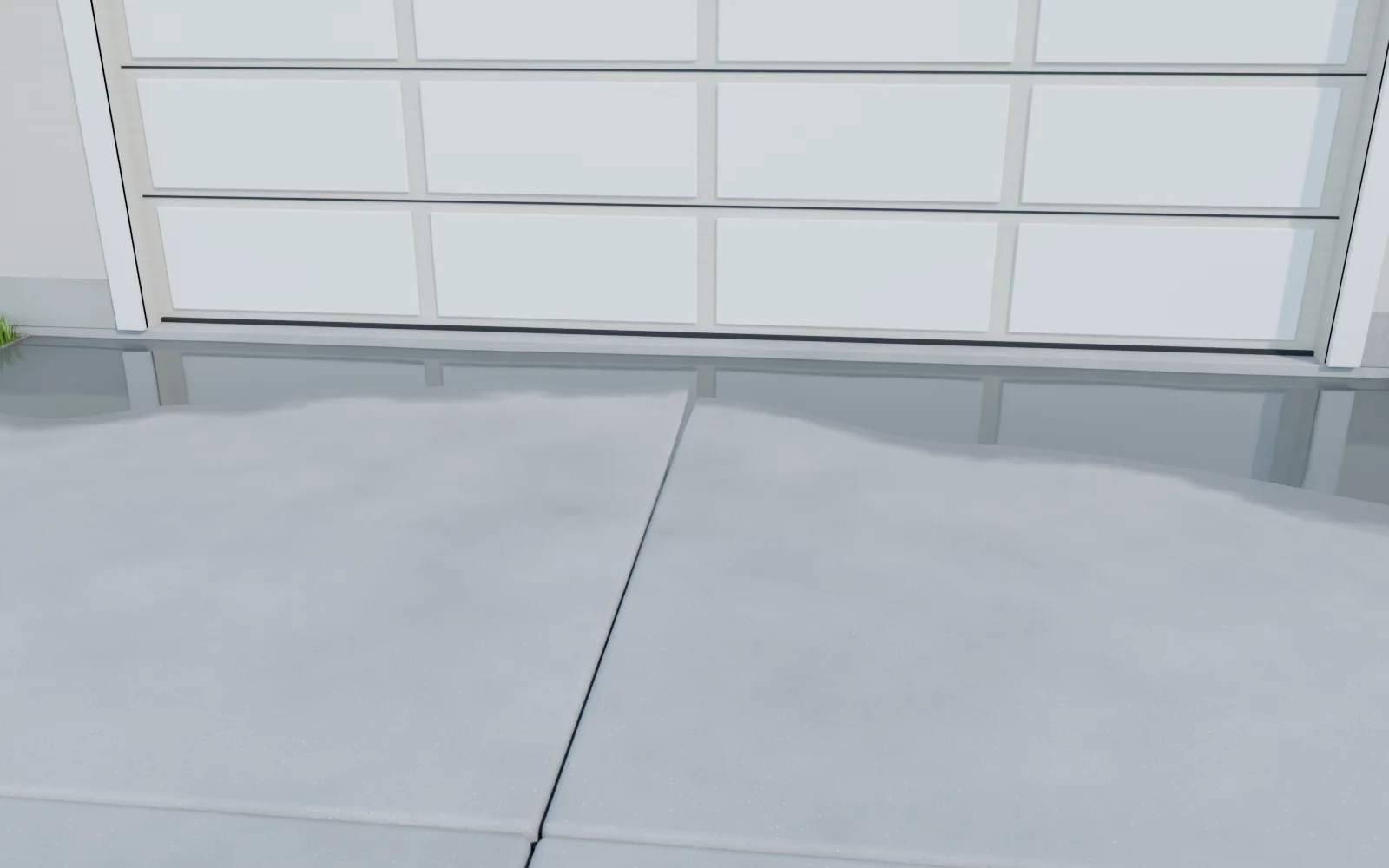
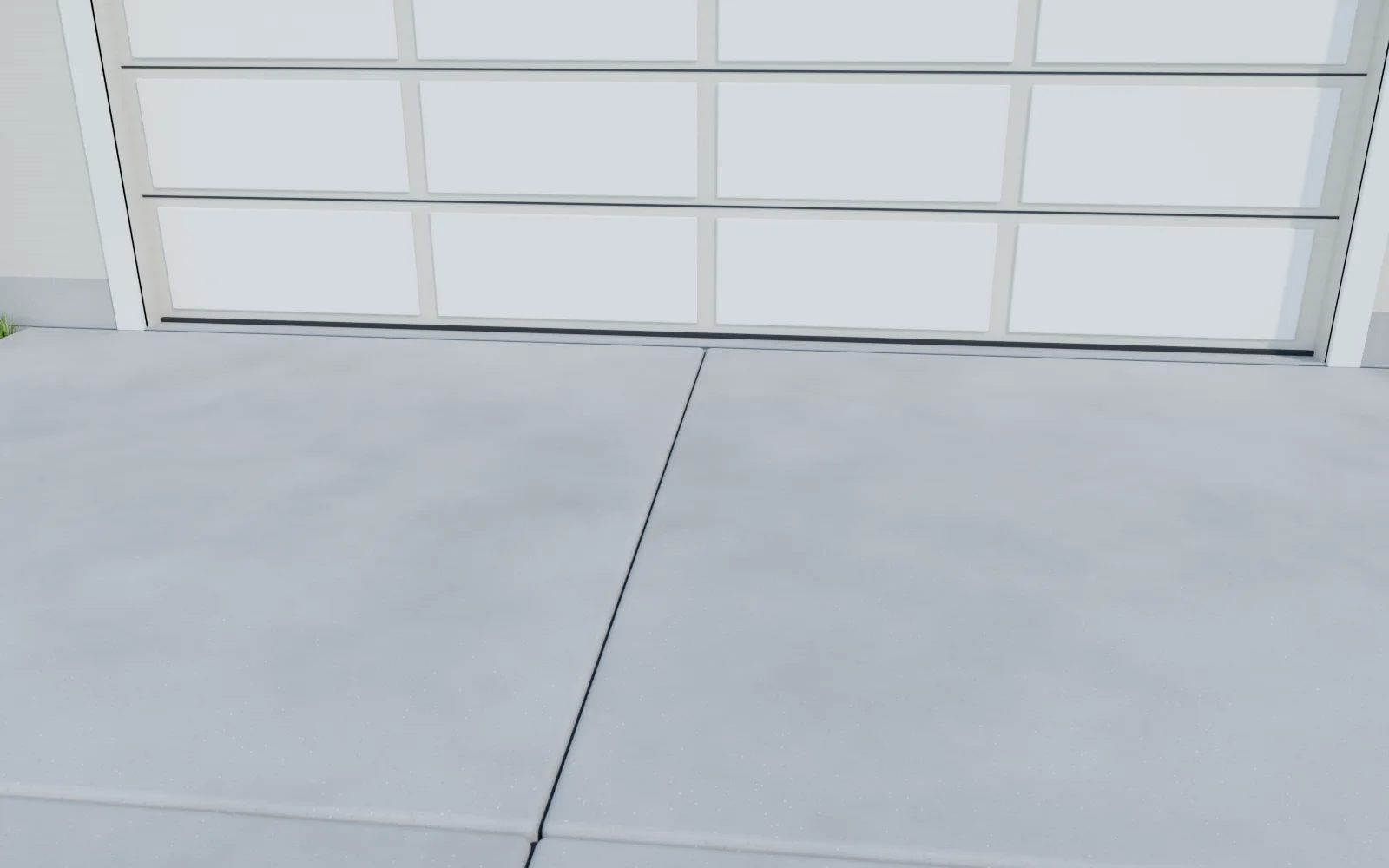
3D render: a garage apron sunk along the garage door, leaving a lip at the garage floor and water standing against the door2″ lip, water at the door3D render
The short answer

A drop between the garage floor and the driveway means the apron slab has sunk, usually 1 to 3 inches, because the backfill under it settled or washed out. We lift it flush with the garage floor through 5/8-inch holes, pitch it away from the door, and seal the joint. Most aprons take about 2 hours, and you can park on them the same day.

By Rob Diederich, owner · Updated
Common drop
1 to 3 inches
Time on site
About 2 hours
Park on it
Same day
Warranty
5-year written warranty
3D render of a garage apron sunk along the whole garage door with water standing against the door, before and after foam lifting — afterFlush, joint sealed
3D render of a garage apron sunk along the whole garage door with water standing against the door, before and after foam lifting — before2″ lip at the door
3D render
The apron dropped along the door, leaving a lip and a puddle against it. Lifted, it meets the garage floor again, pitched away from the door, and the garage joint is sealed. Drag the slider.

Garage apron lifts, before and after

Garage apron sunk at the garage door with a tape measure standing on it, before and after foam lifting — afterBack up at the door
Garage apron sunk at the garage door with a tape measure standing on it, before and after foam lifting — beforeSunk at the door
Example
Garage apron at the doorThe apron had sunk at the garage door and opened a gap along the foundation. Lifted, it sits back up at the door. The tape stands on the slab in both photos. Drag the slider.
Two-car garage door with the apron settled along the whole opening, before and after foam lifting — afterFlush at the door
Two-car garage door with the apron settled along the whole opening, before and after foam lifting — beforeStep at the garage floor
Example
Apron along the whole doorThe apron had settled along the whole door, leaving the edge of the garage floor showing as a step. Lifted, the slab meets the floor from one side to the other. Drag the slider.
Close-up of a tape measure against a garage wall where the apron sank, before and after foam lifting — afterRaised over an inch
Close-up of a tape measure against a garage wall where the apron sank, before and after foam lifting — beforeSlab low on the wall
Example
The same apron, up closeThe same job with a tape on it. As the slab comes up, the bare foundation showing under the siding shrinks by more than an inch. Drag the slider.
Garage apron dropped below the garage floor with old tar filling the gap, before and after foam lifting — afterLevel with the floor
Garage apron dropped below the garage floor with old tar filling the gap, before and after foam lifting — beforeTar-filled drop
Example
Apron with an old tar jointSomeone had filled the drop at this garage door with tar. Lifted, the apron sits level with the garage floor and the gap is down to a thin line. Drag the slider.

Example lifts. Photos from our own local jobs get added as we finish them.

Garage apron repair at a glance

What sankThe apron, which sits on foundation backfill. The garage floor sits on the foundation and stays put.
Common drop1–3 inches at the door
Apron thicknessOften 5–6 inches, thicker than the rest of the driveway
Holes5/8 inch, starting along the low edge by the door
TargetFlush with the garage floor, pitched away from the door
Time on siteAbout 2 hours
Park on itSame day
Then sealThe joint between the garage floor and the apron, where the water got in
Apron thickness from Concrete Network.

Why the apron sinks first

The garage floor sits on the foundation and its footings. The apron right outside sits on the soil that was dug out for the foundation and pushed back in. That fill settles over the years, water from the roof and the driveway soaks into it, and the apron drops away from the garage while the garage floor stays put.
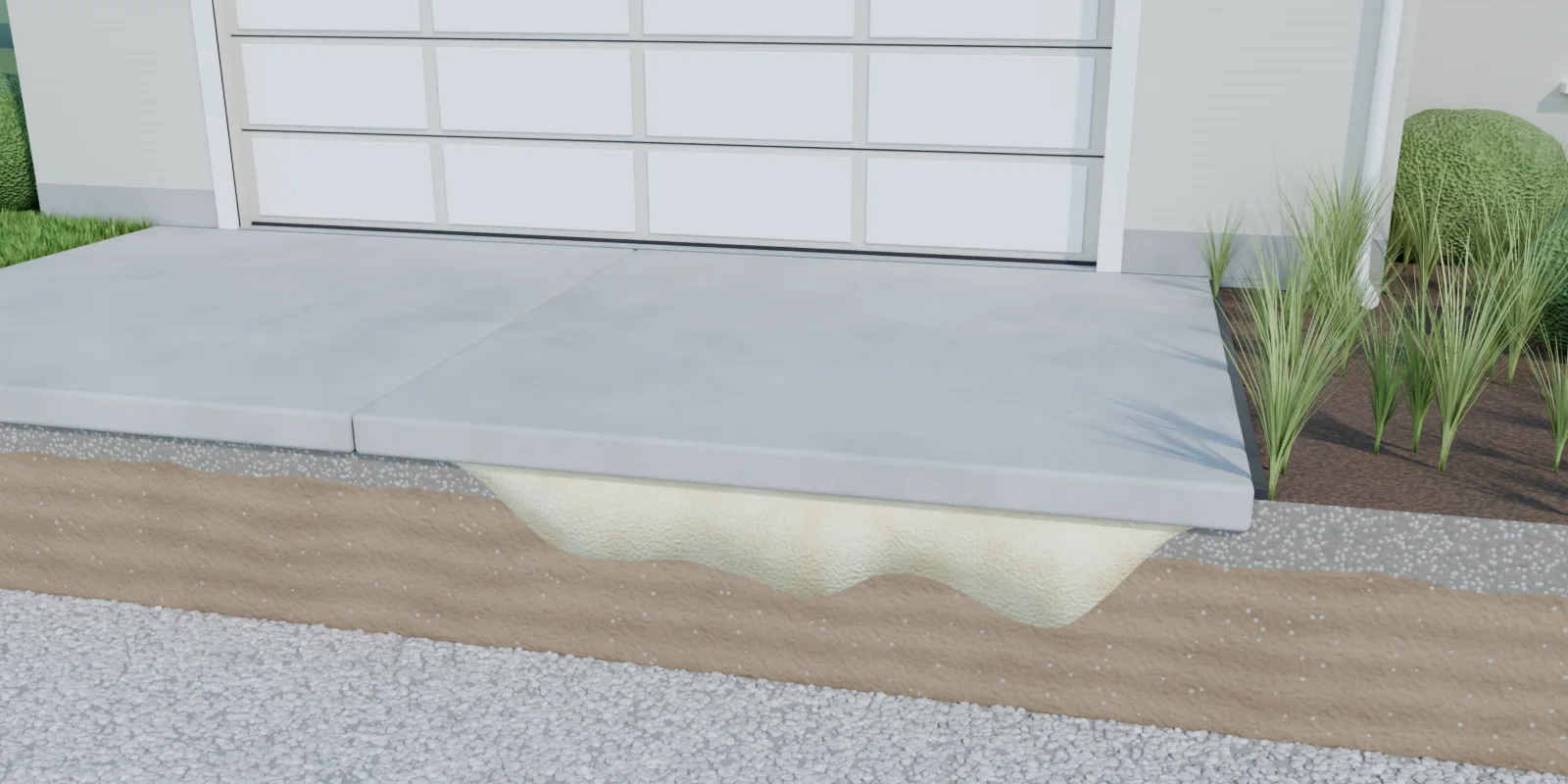
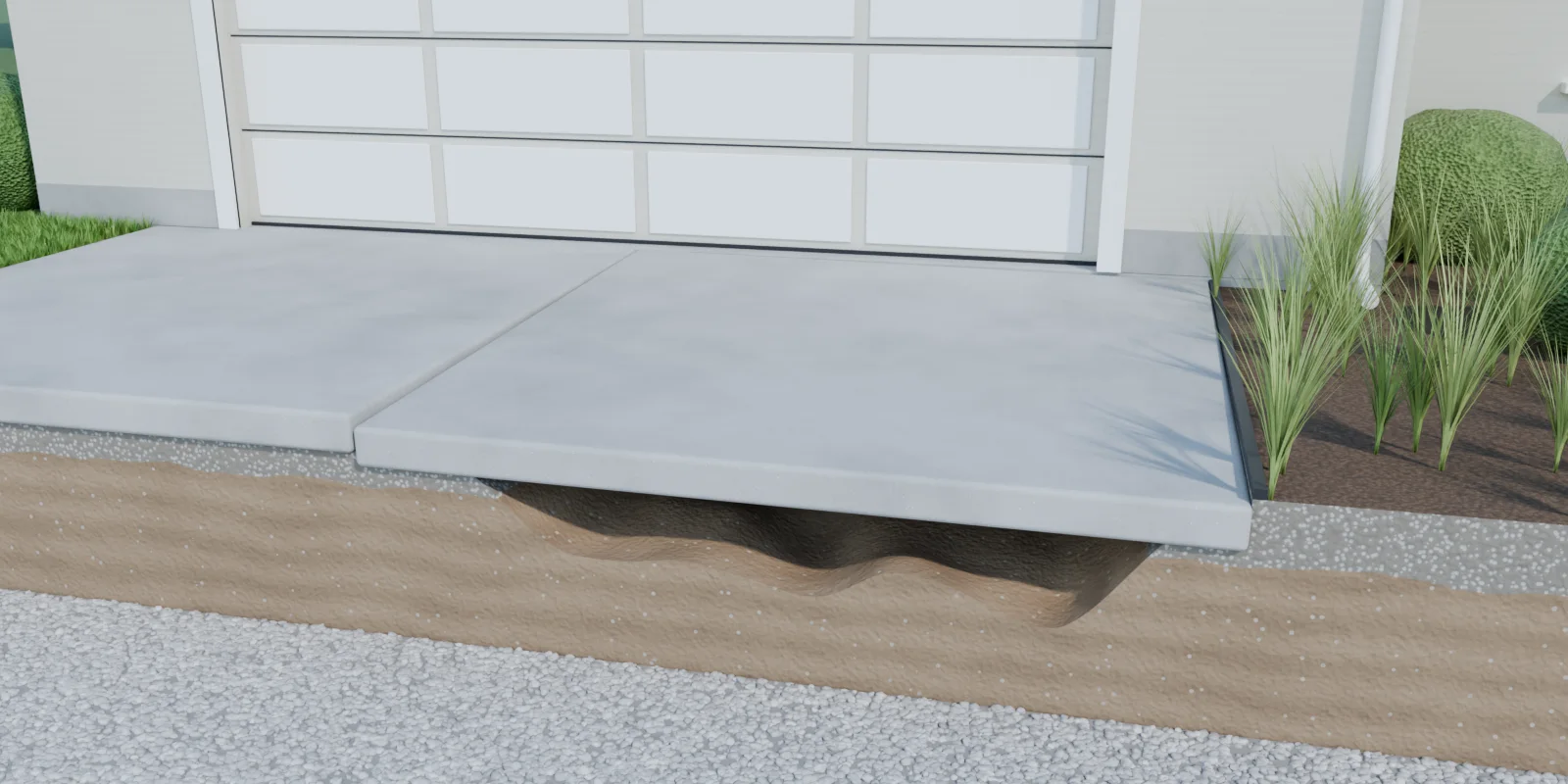
3D cutaway of the ground under a sunken slab beside a garage: a washed-out hollow under the slab, then the hollow filled with foam and the slab lifted level — afterFoam-filled, level
3D cutaway of the ground under a sunken slab beside a garage: a washed-out hollow under the slab, then the hollow filled with foam and the slab lifted level — beforeHollow under the slab
3D render
Under the slab: water washed a hollow out and the slab dropped into it. Foam fills the hollow and lifts the slab back level; the holes are patched and the joint is sealed. Drag the slider.
Settling backfill

The soil pushed back against a new foundation is rarely compacted well. Anything sitting on it settles for years after the house is built.

Fix: Foam fills the voids and stiffens the zone under the slab without adding weight.

Water washout

Roof and downspout water runs into open joints and carries fine soil out from under the slab. The slab drops into the hollow.

Fix: We seal the joints, and point out downspouts that need extending.

Freeze-thaw

Clay-heavy Green Bay soil holds water. Every winter it freezes, swells and thaws softer, loosening the base a little more each year.

Fix: Sealed joints keep water out of the base, which is what freezes.

The apron also lives outside while the garage floor stays sheltered. It goes through freeze and thaw all winter, and the joint between the two takes the beating: every melt, water runs down the driveway, soaks in at that joint and gets under the apron. Tires finish the job. The apron carries every car that comes and goes, and a slab bridging a hollow bends under each one, which is why aprons crack at the corners where wheels cross the edge.

Problems a sunken apron causes

  • A lip you feel every time you drive in, and that catches snowblowers and shovels.
  • Water and slush that run back toward the garage door instead of away from it.
  • A garage door seal that no longer meets the concrete, letting in water, cold air and mice.
  • A trip hazard for anyone walking in and out of the garage.

How to measure the drop at the garage door

  1. 1Lay a board across the door lineSet a straight board or a level on the garage floor so it sticks out over the apron. Measure from the underside of the board down to the apron. That number is how far the apron has to come up.
  2. 2Check both ends of the doorMeasure at the left jamb and the right. Equal numbers mean the apron dropped evenly. Different numbers mean it tipped, often toward the corner where a downspout lets out.
  3. 3Close the door and look at the sealA gap under one end of the closed overhead door points to the concrete, as long as the door itself hangs level.
  4. 4Watch where meltwater goesWater should leave the door and run down the driveway. Water that ponds at the threshold means the apron now tips back toward the garage.
  5. 5Take the photoStand the tape at the lip, next to the garage floor, close enough that the numbers read. That one shot prices most aprons.

An apron that sits high in January and is back flush by June was pushed up by frost. There's nothing to lift; fix where the water goes. A step down that's still there in August is settling, and it tends to grow each year. See frost heave vs. settling.

How we fix it, step by step

  1. 1Use the garage floor as the targetThe garage floor sits on the foundation and didn't move, so it's the reference. We set the apron to meet it, pitched away from the door.
  2. 2Drill 5/8″ holes, set the portsDime-sized holes go through the slab a few feet apart, kept off the edges and corners where concrete is weakest. A plastic injection port is tapped into each one.
  3. 3Inject and lift, door edge firstFoam fills the void under the apron, then each short shot lifts it. We start along the low edge by the door so the apron rotates up flush instead of rocking.
  4. 4Patch and seal the garage jointHoles are grouted, and the joint between the garage floor and the apron gets flexible sealant. That joint is where the water got in.

3D renders with the ground cut away, simplified to fewer holes than a real job. Most residential jobs take a few hours, and you can walk on the slab when we pack up.

Four things are particular to an apron:

  • The garage floor is the reference. The apron comes up until it's flush with the floor at the door, then gets checked along its outer joint so it still falls toward the driveway.
  • The next section is checked too. If the driveway section below the apron dropped with it, both are lifted on the same visit so the whole run drains toward the street.
  • The joint at the door is sealed last. That joint is where the water got in. The sealant is finished slightly below the surface so shovels and plow blades ride over it.
  • Cars come out first. The apron is the only way out of the garage, so pull out any car you'll need for the two hours or so we're there.

Planning a garage floor coating? Lift the apron first. A level transition makes the coated floor look finished and keeps water off it.

When a sunken apron can't be lifted

  • It's in many pieces. One big corner piece that's still tight against the slab usually rises with it. Four or more loose pieces won't come up as one surface.
  • It was pushed up, not down. An apron heaved by a root can't be pushed back, and there's little room to blend it into its neighbors: it has to meet the garage floor and still shed water away from the door.
  • The concrete is crumbling through. Salt flaking on a solid slab is a surface problem and the apron still lifts. Concrete breaking down deep is a replacement.

Replacement is a concrete contractor's job; we don't pour. If only the apron is shot and the driveway below it sank, the contractor replaces that one slab and we lift the rest. The lift or replace guide shows how to tell which you have.

Why lift the apron instead of replacing it?

The apron is the one slab you drive over every day. Replacing it closes the garage to cars for about a week, and the new slab goes back on the same backfill. Lifting fills the voids in that backfill and you park in the garage the same day.

Fraction
of what tearing out and pouring new concrete costs
Same day
Walk on it when we pack up. Drive on it the same day, not a week later.
No demo
No jackhammers, no dumpster, no torn-up lawn or landscaping.
5/8″ holes
Dime-sized and patched flush. No new slab that won't match.
Stays up
Foam adds almost no weight and doesn't wash out like soil.
Warranty
5-year re-lift warranty, in writing on your quote before you approve it.

Replacement timing is typical; a contractor's schedule and the weather can stretch it. New-concrete cure times from Concrete Network.

What garage apron repair costs

Most garage apron repairs are one to three sections, so they often land near the job minimum. Full details are in the leveling cost guide.

Apron jobTypical price
Typical apron, about 100 sq ft$400–$1,000
Apron plus the next driveway section or two, 200–300 sq ft$800–$3,000
Job minimum$300
Sealing the joint at the door$5–$10 per foot, no separate caulking minimum with a lift
From our price sheet. The firm number for your apron comes from your photos.

What pushes an apron toward the top of its range is the hollow under it. Fine soil washes out first, so the void usually runs further back under the slab than the gap you can see at its edge. If there's a gap under the side of the apron, photograph it.

Lifting ballpark

Pick the job that looks like yours.

We price by the foam the job takes, $4–$10 per sq ft on average with a $300 minimum. Add the size and how far it dropped for a closer number; your photos make it a firm price.

1.What sank?
sq ft of low concreteA driveway section is about 100 sq ft; a sidewalk panel about 20.
3.How far did it drop? (at the lowest edge)

Stand a tape measure at the low edge and read the gap to the slab next to it.

4.How did it sink?
Ballpark

Pick a job or enter a size and the range appears here.

What moves it: how far it dropped, how many sections, what the slab is sitting on, and how close we can park. The cost guide explains each.

Get the firm number

Leave your name and mobile. We text you within 24 hours, and three photos make it a firm price, no site visit for most jobs.

By sending, you agree we can text or call you about this request. No spam. Privacy

Have photos now? Use the full photo form and skip the back-and-forth.

Send a photo of the drop at the door
Stand a tape measure at the lip and shoot it next to the garage floor. Firm price by text or email within 24 hours.
Get My Price

After the apron is lifted: keeping it flush with the garage floor

Level apron, sealed joints, and a few dime-sized gray patches where the foam went in. The patches are close to concrete color and fade into older slabs within a season. We text you before-and-after photos before we leave.

Keeping it level means keeping water out from under it. Three things do most of the work: keep the joints and cracks sealed, backfill soil against any slab edge the lift left exposed, and keep downspouts discharging away from the concrete. Sealing is its own line on your quote; the rest is in what to do after your concrete is lifted.

  • Look at the door joint each spring. If the sealant has torn, water is getting back into the backfill.
  • Extend the downspouts at the garage corners so they let out several feet away, on ground that slopes away from the driveway. Here's how to extend downspouts.
  • Fill along the sides. If the lift left the apron's edge standing above the soil, pack topsoil against it so water runs off instead of under.

Sources

  1. Concrete Network: how thick should a concrete driveway be?
Questions

Common questions

Why is there a drop between my garage and driveway?

The garage floor rests on the foundation, but the driveway apron rests on backfill from when the house was built. That fill compacts and washes out over time, so the apron sinks while the garage floor stays where it is.

Can a sunken garage apron be raised?

Yes, as long as the apron slab is still in one piece or a few big pieces. Foam is injected under it to bring it back flush with the garage floor and pitched away from the door.

Will my garage door seal properly after the apron is lifted?

In most cases, yes. Once the apron is back up to the garage floor, the bottom seal of the door meets the concrete again. If the seal itself is worn, replacing it is a cheap fix we can point out.

How do I stop water from getting under my garage slab?

Keep the apron pitched away from the door, seal the joint between the apron and the garage floor, and make sure downspouts near the garage discharge away from the driveway.

Why do garage aprons sink in newer homes?

The apron sits on the soil that was dug out for the basement and pushed back in. That backfill keeps settling for years after the house is built, and roof and driveway water soaks into it, so the apron is often the first slab to drop, sometimes within the first few years.

Is a small drop at the garage door worth fixing?

Usually, yes. Even an inch can send rain and meltwater back toward the door and into the joint, and that water keeps washing out the backfill under the apron, so the drop tends to grow each spring. A small drop is also the cheapest one to fix, because a small void takes less foam to fill.

How can I tell if the apron sank or the garage floor did?

Lay a straight board or level across the door line. If the step down is right at the door and the floor inside runs straight out to it, the apron sank. If the floor itself dips in its last few feet before the door, its edge settled too. Then we lift the floor first and set the apron to meet it, in the same visit.

Will lifting the apron keep my garage door from freezing to the concrete?

Usually, if a sunken apron is why water collects there. A door freezes down when slush and meltwater pool against its bottom seal and refreeze overnight. Lifting the apron flush with the garage floor and pitched away from the door lets that water drain off, and sealing the joint at the door keeps it from soaking in underneath.

Will lifting the apron stop my snowblower and plow from catching at the garage?

Yes. The lip at the door is what a plow blade or a snowblower's scraper bar hits. Once the apron is flush with the garage floor, there's no edge left to catch. The sealant in the joint at the door is finished slightly below the surface, so blades ride over it instead of peeling it out.

Will lifting the apron leave a bump where it meets the rest of the driveway?

No. We set the apron on a line from the garage floor down to the driveway section below it, so it ends up flush at the door, flush at its outer joint, and pitched away from the garage. If that next section dropped too, we lift it on the same visit and the same quote, so the whole run drains toward the street.

The apron in front of my garage is flaking. Can it still be lifted?

Usually, yes. Flaking from road salt and freeze-thaw is a surface problem, and if the slab under it is solid and in one or a few large pieces, it lifts like any other apron. Lifting won't restore the flaked surface, though. If the concrete is crumbling deep or broken into many pieces, replacement is the better call, and we'll say so from your photos.

How long will my garage be blocked while you lift the apron?

About 2 hours. Pull your cars out before we start if you'll need them, since the apron is the only way out, and nothing inside the garage has to move. You can park inside again the same day, once the hole patches have set.

How much does it cost to fix a sunken garage apron in Green Bay?

Usually $400 to $1,000 for a typical apron of about 100 square feet, lifted flush with the garage floor. Our job minimum is $300. Sealing the joint at the door adds its footage at $5 to $10 per foot, with no separate caulking minimum when it's done with the lift. An apron over a big washout can run higher; we'll say so from your photos.

Should I fix my garage apron before getting the garage floor coated?

Yes. Lift the apron first, so the coated floor ends at a flush, finished edge and water runs away from the door instead of onto the new coating. The joint at the door is sealed after the lift. We can price the lift and a garage floor coating from the same set of photos.

Is a lifted garage apron covered by a warranty?

Yes. Every lift comes with a written warranty, and the written warranty on your quote spells out what's covered before you approve it. Because the apron sits on backfill that soaks up roof water, keeping the joint at the door sealed and the nearby downspouts emptying away from the driveway does the most to keep it flush.

Keep reading

Related

Concrete leveling · Driveways
Driveway Leveling

Sunken driveway slab or garage apron? Foam lifting raises it back to grade through small holes, and you can drive on it the same day. Free photo quote.

Polyurea flake floors · Green Bay & NE Wisconsin
Garage Floor Coatings

Garage floor coatings in Green Bay, $6–$9 per sq ft: polyurea base, polyaspartic UV topcoat. Looking for epoxy flooring? See what we install instead.

Protect the repair
Crack & Joint Caulking

Seal driveway joints, cracks and the gap at your foundation with flexible polyurethane sealant. Keeps water and salt out. Free photo quote.

Get your price from a few photos

Send three phone photos and a quick measurement. You'll get a firm price by text or email within 24 hours, no site visit needed for most jobs.

Get My PriceCall (920) 655-2193