
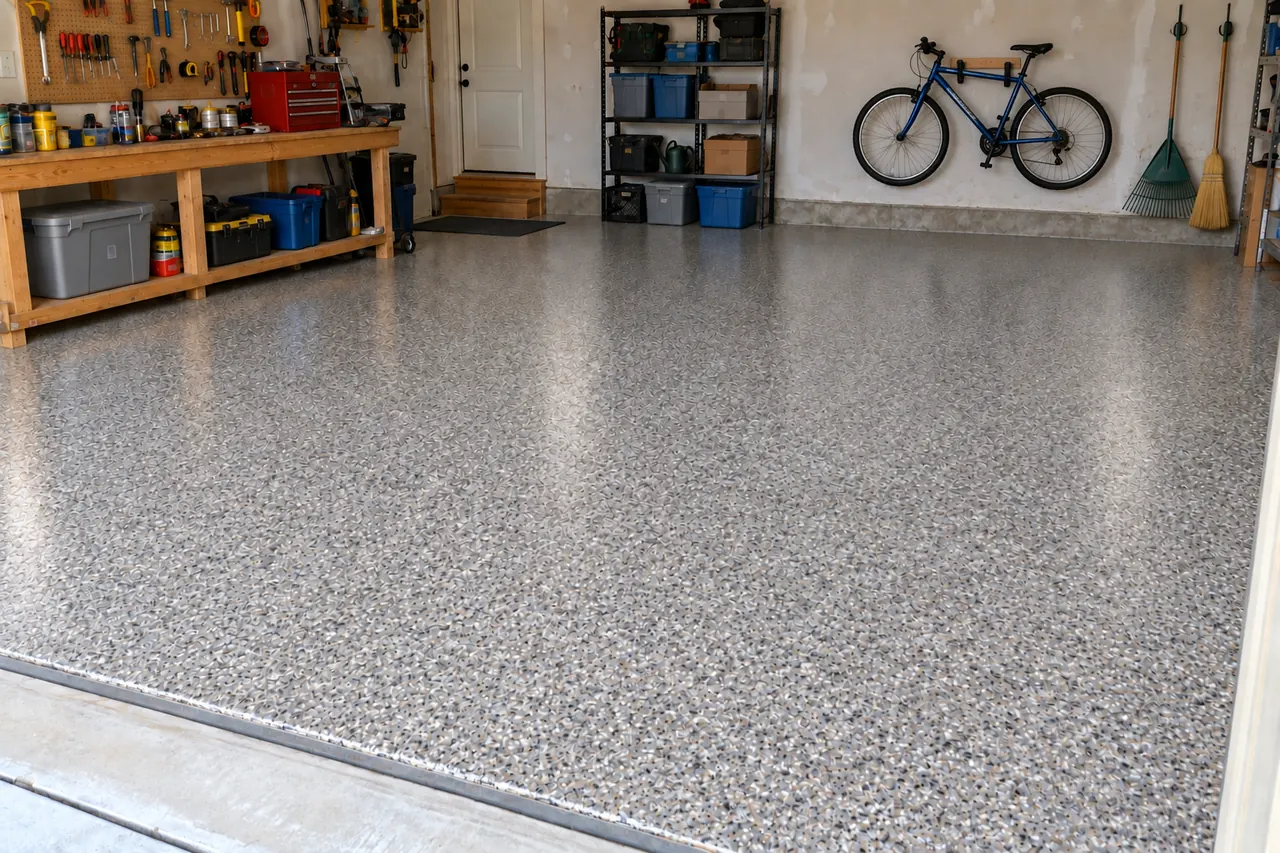
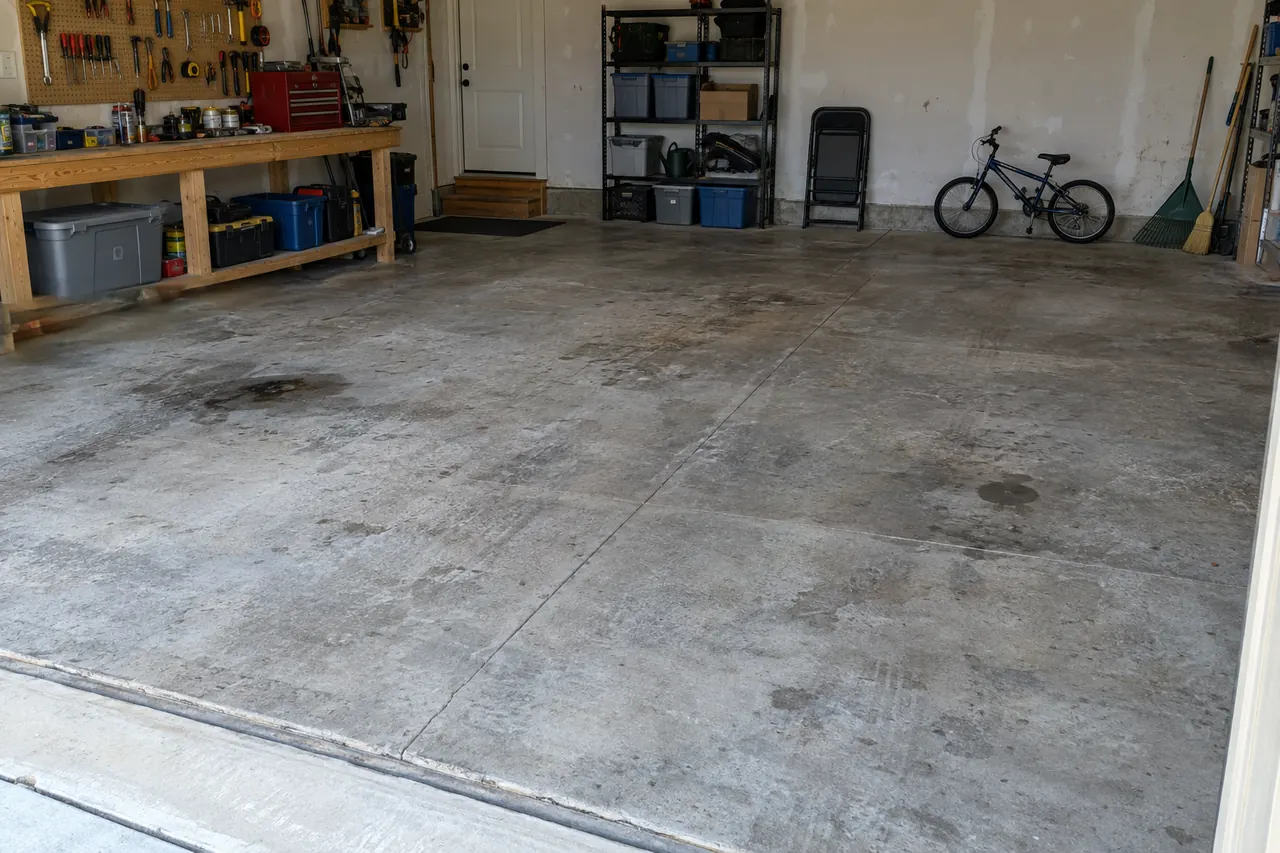
Full flake floor coating at a glance
What full broadcast means
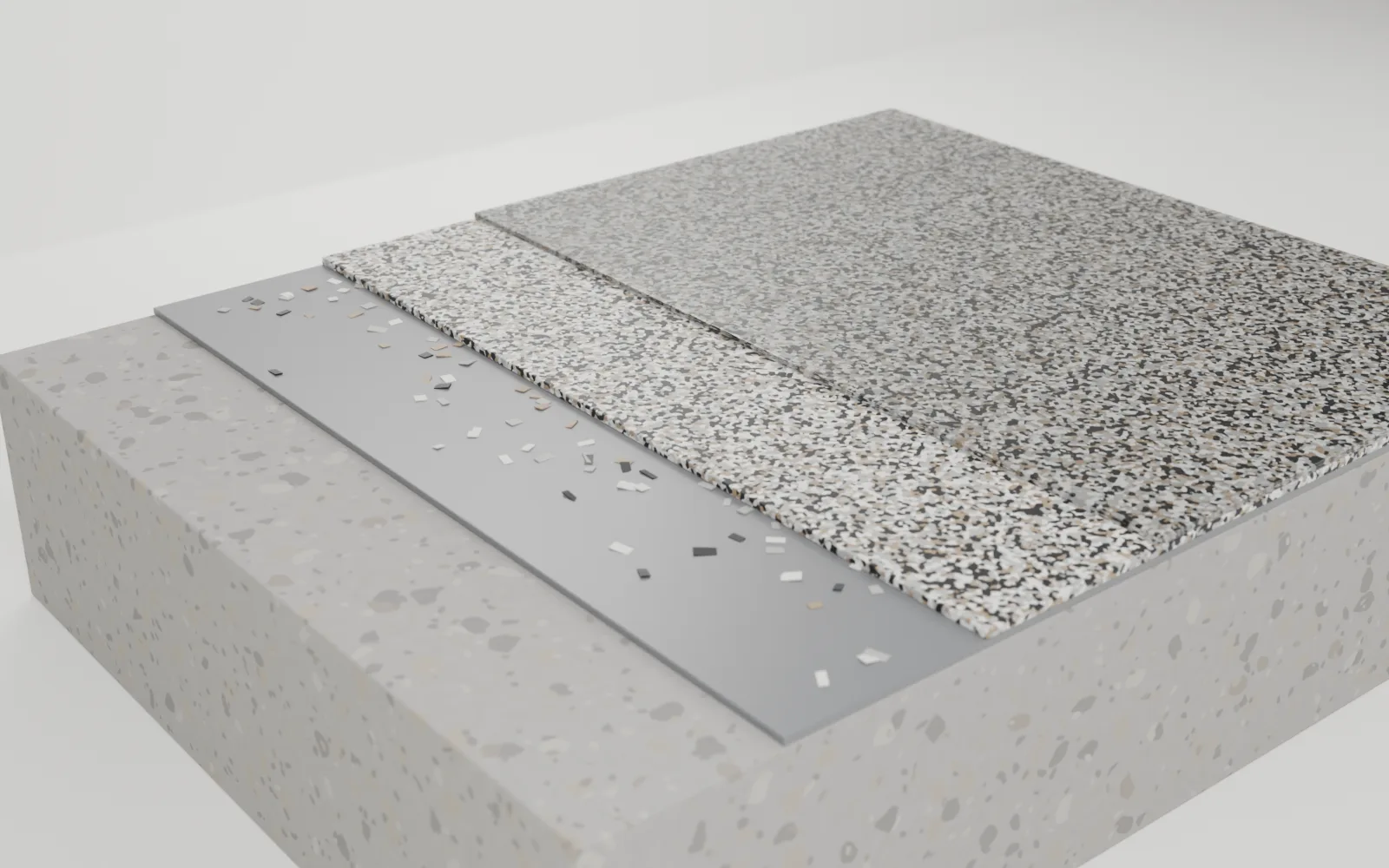
- 1Grind and repairThe floor is diamond ground to about CSP 2–3 and the cracks and pits are filled.
- 2Base coatA pigmented base coat goes down and bonds into the ground concrete.
- 3Flake to refusalWhile it's wet, flake is thrown across the whole floor until the base won't take any more.
- 4Scrape and sweepThe loose flake comes off, leaving a fully covered, textured surface.
- 5Clear topcoatA UV-stable polyaspartic topcoat locks the flake in and takes the wear.
Full flake vs. partial flake vs. solid color
| Full flake | Partial flake | Solid color | |
|---|---|---|---|
| What you see | All flake | Base color with flecks | One even color |
| Hides dust and flaws | Best | Some | Least |
| Texture underfoot | Most | Less | Smooth unless grit is added |
| Good for | Garages, shops, entries | Basements, rec rooms, showrooms | Shops, storage, commercial back rooms |
Picking a flake blend
Light blends hide dust and brighten the room. Dark blends hide tire marks and oil. Bigger flakes look bolder; smaller ones look finer and more like stone. We bring real samples, because colors on a screen never match colors on a floor.
More on flake sizes, broadcast and price in flake garage floors.
Who full flake is for
It's our standard garage floor, and it's the right pick anywhere a floor takes dirt and has to keep looking good: garages, shops, pole barns, entries and busy basements. With flake covering the whole floor and no base color showing, old stains, patched spots and color differences in the concrete disappear, and the pattern keeps hiding dust, salt film and tire marks between cleanings. With grit in the topcoat it also works on porches and patios.
If you want a calmer look for a room that stays clean, partial flake shows more of the base color. If you want to spot a dropped bolt or a new leak at a glance, solid color has no flake at all.
How prep and install differ for full flake
- The grind is the same as every floor we coat: the whole slab, edges included, to about CSP 2–3 with dust extraction. Cracks and pits are filled and ground flush.
- Oil still has to come out. The flake will hide a stain, but oil that has soaked deep into the slab can keep the base coat from bonding, so it's dealt with in prep.
- Two steps other finishes don't have. The flake is broadcast to refusal, then the loose flake is scraped and swept off. What's left is a fully covered, textured surface.
- It's a thicker build than partial flake. Each polyaspartic coat goes on at about 6 to 12 mils dry, and full flake stacks a base coat, a solid layer of flake and a clear topcoat. That thickness, with a bond into ground concrete, is what keeps hot tires from lifting it.
- Texture can be set for the room. The topcoat can be finished smoother for a basement you walk in socks, or with grit added where snowmelt comes in off the cars.
What it costs
Full flake is $6–$9 per square foot installed, with a $2,000 minimum. By garage size:
| Floor | Square feet | Installed price |
|---|---|---|
| One-car garage, 12 × 24 | 288 | $2,000–$2,592 |
| Two-car garage, 20 × 20 | 400 | $2,400–$3,600 |
| Two-car garage, 24 × 24 | 576 | $3,456–$5,184 |
| Three-car garage, 24 × 36 | 864 | $5,184–$7,776 |
That covers diamond grinding, crack repair, the base coat, the flake or color and the topcoat on sound concrete. Heavy crack repair or grinding off an old coating is extra, and photos of the floor get you a firm number. Nationally, professional floor coatings run about $4 to $12 per square foot installed (HomeGuide).
How long it takes
Usually one day for a one- or two-car garage. Grinding, repairs, the base coat, the flake broadcast, scraping and the clear topcoat all happen the same day, because polyaspartic can be recoated within hours. Bigger floors or heavy repairs can take longer. You can walk on it within a few hours and park after about 24 to 48 hours.
Care and repairs
The texture is sealed under the clear topcoat, so dirt sits on top instead of working into it. Sweep or dust mop, squeegee out slush, and wash with a pH-neutral cleaner and a microfiber mop or soft deck brush. A chip from a dropped tool can be cleaned out, filled, re-flaked and topcoated, and the busy pattern hides the edges of a repair well. If the topcoat dulls in the tire paths after years of use, a well-bonded floor can usually be cleaned, sanded and given a fresh clear topcoat without grinding off the flake.
What to send for a quote
The photo estimate form asks what kind of floor it is, its size (length and width, or square feet) and what shape it's in: bare concrete in decent shape; cracks, pits or salt damage; or an old coating or paint. Then it asks for three photos:
- Whole floor. From the doorway, with the walls and the door in the shot.
- Up close. Cracks, pits, salt damage or peeling, with a coin or tape for scale.
- Edges and steps. Where the floor meets the walls, steps, a drain or the apron.
- For a full flake floor: tell us the look you like, light or dark, bold or fine, and we'll bring real samples to match.
You'll get a firm price by text or email within 24 hours, with anything extra, like heavy repair or an old coating to grind off, priced on the quote before you decide. More questions, including stains and patches, fading by the door, chip repairs, recoating and the warranty, are answered in the floor coating FAQ.