
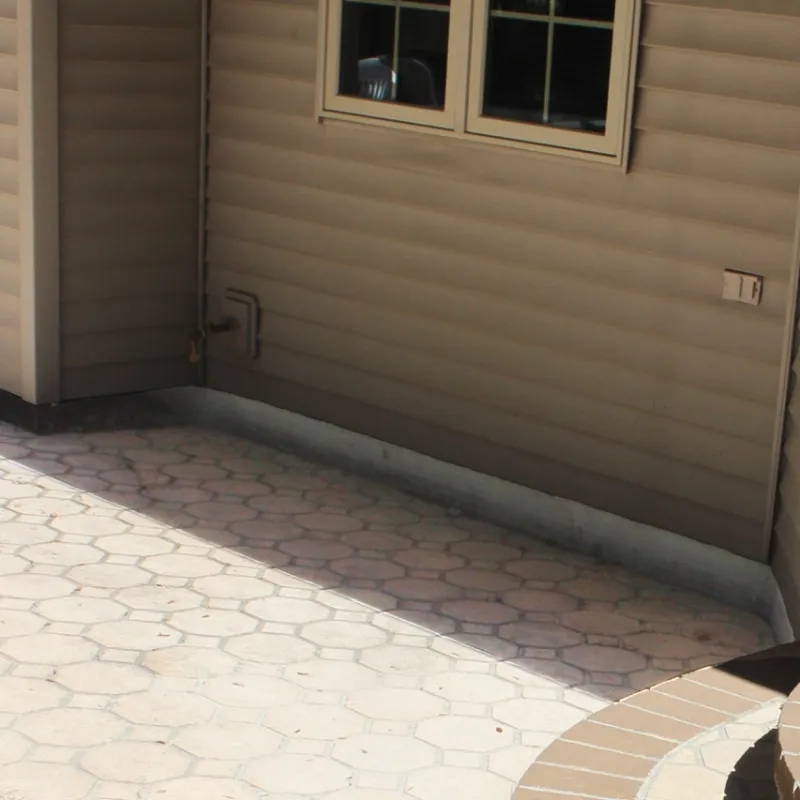
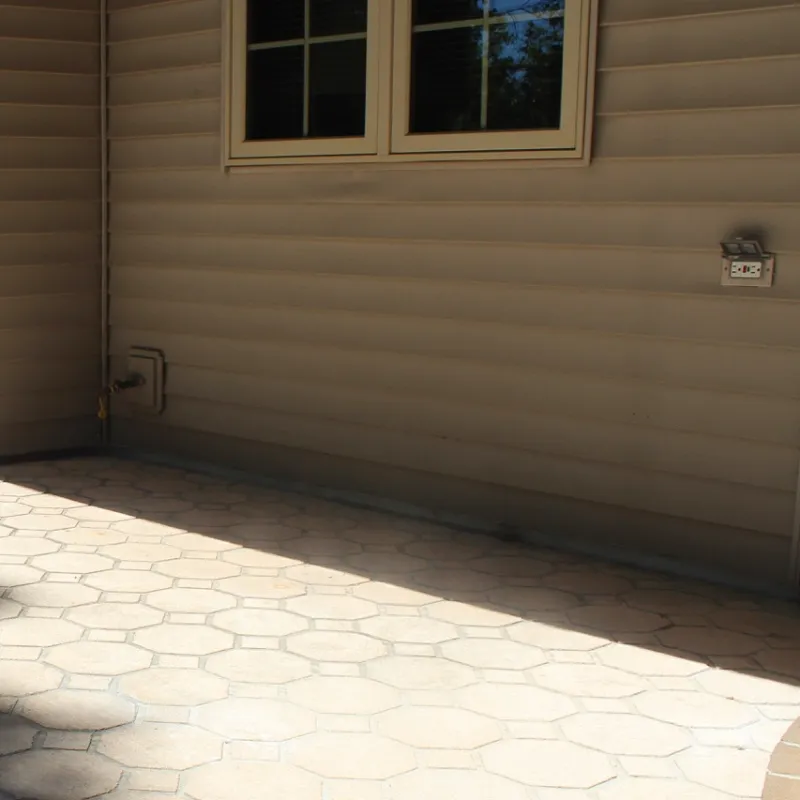
Example lifts. Photos from our own local jobs get added as we finish them.
Why lift decorative concrete instead of replacing it
Stamped, colored and exposed-aggregate concrete is the most expensive concrete around a house to pour and the hardest to match. Stamp patterns, color, release agents and sealers change from installer to installer and pour to pour, so a replaced section almost always looks like a patch. Lifting keeps the original slab, pattern and color.
Decorative concrete leveling at a glance
Signs your stamped or decorative concrete needs lifting
- A crack running through the pattern, with one side lower than the other.
- A section that rocks or sounds hollow when you walk on it.
- An edge pulling away from the steps, the house or a pool coping.
- Water standing where it used to drain off.
- A lip at a joint or pattern line that used to be flush.
Sunk, or just due for resealing? How to tell
Look at the joints and pattern lines, not the color. To measure a drop, lay a straight board across the joint or crack and measure under it.
| What you see | What it is | The fix |
|---|---|---|
| A lip at a joint or pattern line, or a crack with one side lower | The slab sank | Lift it |
| Water standing where it used to drain, or a section that rocks or sounds hollow | A void under the slab | Lift it, or fill the void if it's still at the right height |
| Faded color, a white haze or peeling film on a slab that's still level | A sealer problem | Reseal. A failing film may have to come off first |
| Flaking or pitting on a level slab | Surface damage from salt and freeze-thaw | Not a lifting job. A lift leaves the surface as it is |
| A hump on the side facing a tree | Root heave | Grind, blend or replace. Foam can't push a slab down |
Why decorative concrete sinks
The same way plain concrete does: the soil under it moves. A decorative finish doesn't change what's underneath, and patios and pool surrounds often sit right on foundation backfill or soil that stays wet.
How we lift it without hurting the finish
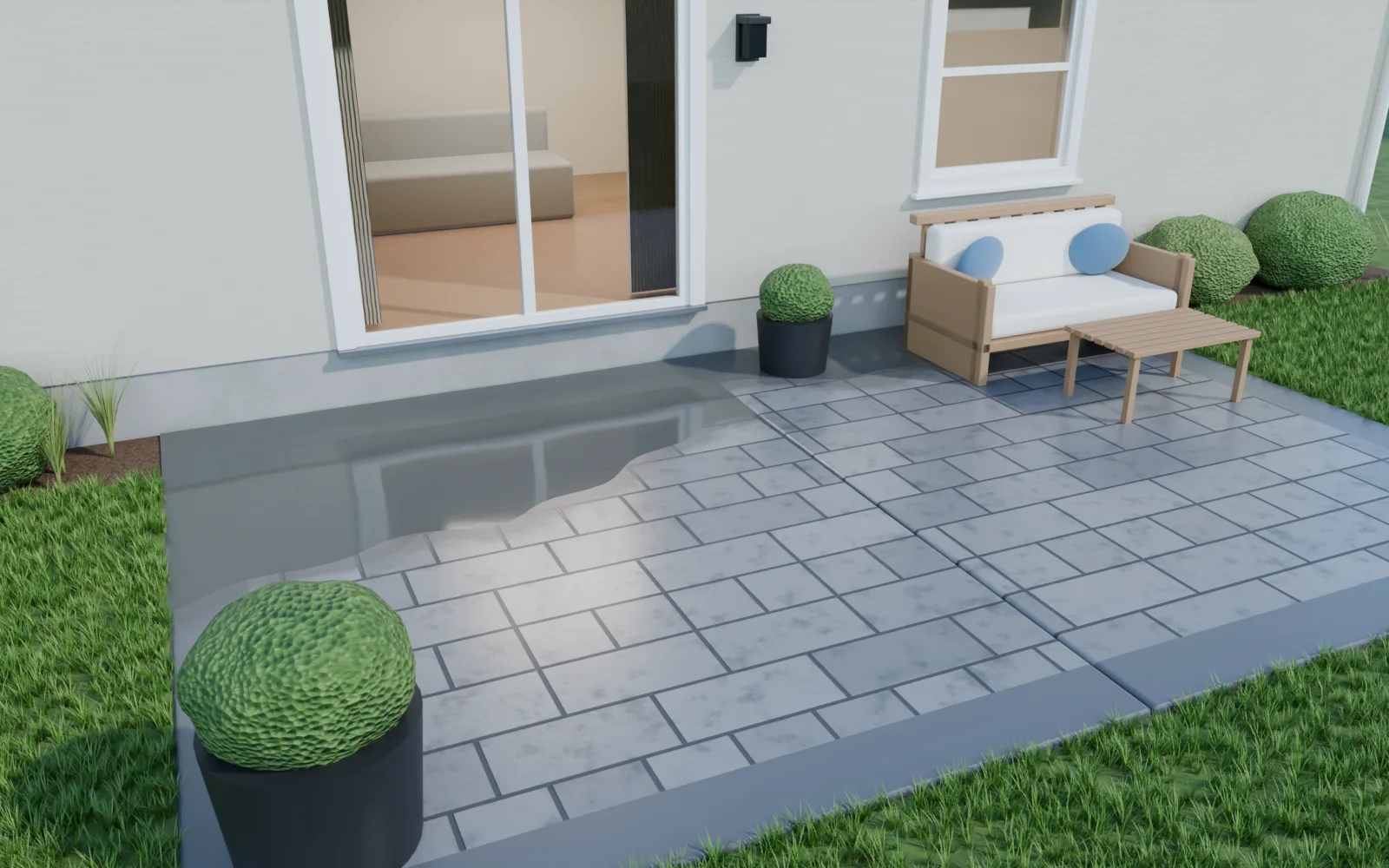
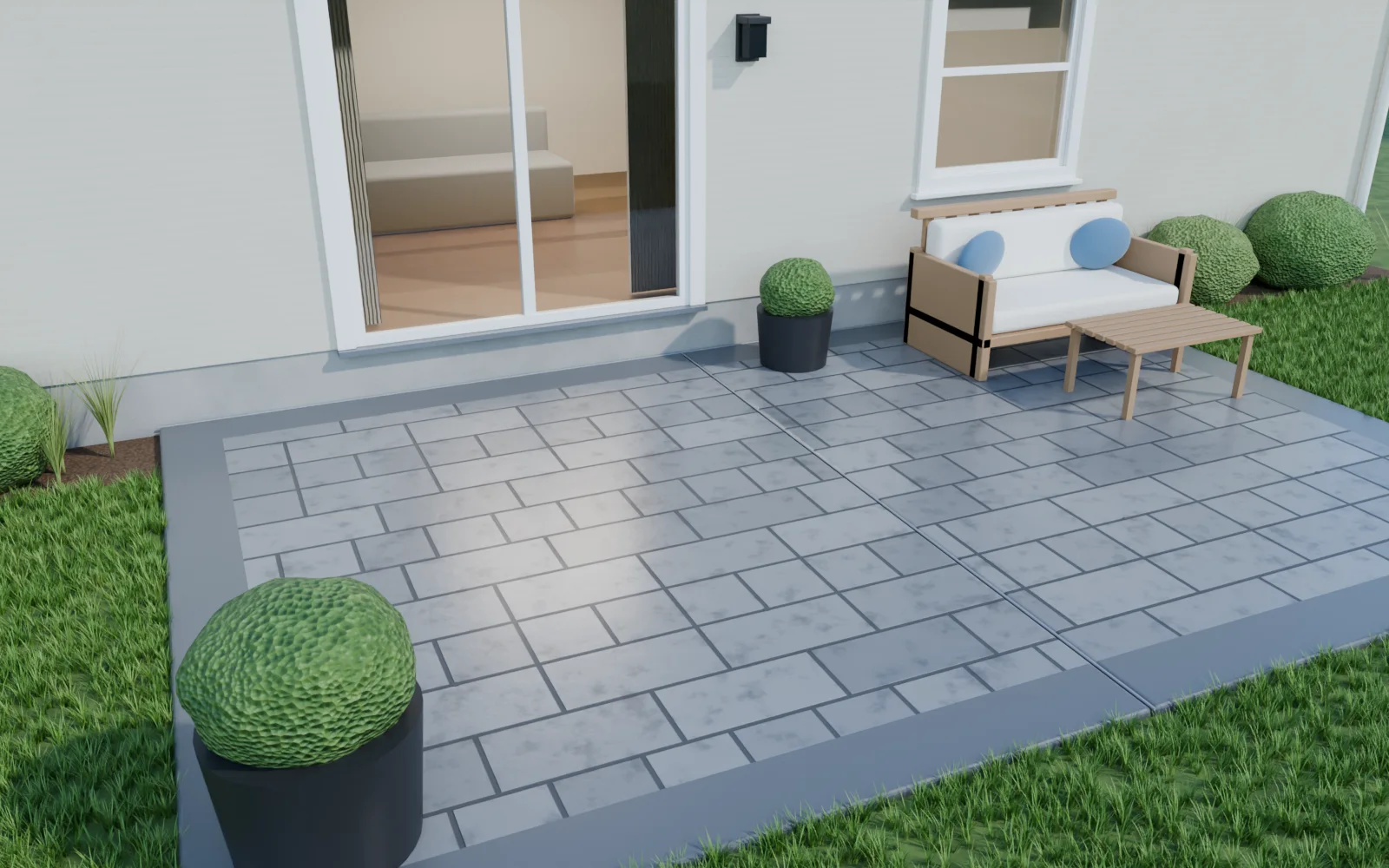
Hole placement and patching are what matter most on a decorative slab. Before drilling, we map the pattern and put each hole in a grout line, a joint or the darkest part of the texture. After the lift, the holes are packed with grout tinted to the surface, so they read as part of the pattern rather than as dots.
3D renders with the ground cut away, simplified to fewer holes than a real job. Most residential jobs take a few hours, and you can walk on the slab when we pack up.
What stays visible afterward
The patches sit flush, but up close they're still small dots, and they show more on stamped, colored or exposed-aggregate concrete than on plain gray. On exposed aggregate a grout plug can't copy the stones. A crack stays a crack: once the low side is flush the pattern lines up across it again, and it's filled with sealant set slightly low so it reads as one more line. A fresh coat of decorative sealer over the tinted patches gives the closest blend.
Grinding, mudjacking or an overlay on stamped concrete
Every other way of dealing with a lip costs a decorative slab more of its finish than a lift does.
| Fix | What it does to a decorative surface |
|---|---|
| Grinding the lip | Leaves a lighter, rougher strip and often exposes the stone inside the concrete. Stamped, colored and exposed-aggregate slabs are where that strip shows most |
| Mudjacking | Needs holes about 1½–2 inches across, which are hard to hide in a pattern |
| A stamped overlay | Follows the slab under it, so a section that sank is still low with a new pattern on top, and movement can crack the overlay |
| Replacing a section | New stamp, color and sealer beside the old rarely match |
| Foam lifting | 5/8-inch holes set in grout lines and patched with tinted grout. The pattern and color stay |
When stamped concrete can't be saved by lifting
- One section is in many pieces. That section is replaced by a decorative concrete contractor, since we don't pour or stamp. Lifting the sections around it first lets them pour to slabs that are back where they belong.
- A root pushed it up. A patio or pool surround has to stay flat for furniture and drainage, so raising the neighbors to meet a hump isn't a fix.
- The surface itself is failing. Deep flaking rides along with the slab. A level version of it still flakes.
- It's pavers or stone, not a slab. Those are pulled up and re-set on a re-leveled base.
Why lift instead of replacing stamped concrete?
Replacing a stamped section means breaking out concrete you paid extra for, re-stamping a pattern that won't quite line up, and waiting about a week for it to cure. Lifting is one visit, and the surface you chose stays.
Replacement timing is typical; a contractor's schedule and the weather can stretch it. New-concrete cure times from Concrete Network.
What stamped concrete leveling costs
Decorative slabs are priced the same way as plain ones, by the section and the drop, with a little extra time for mapping holes into the pattern and tinting the patches. See the leveling cost guide.
| Decorative job | Typical price |
|---|---|
| Single stamped walk section | $300–$600 |
| Stamped patio of one or two slabs, about 150 sq ft | $600–$1,500 |
| Larger areas | $4–$10 per sq ft |
| Job minimum | $300 |
| Decorative reseal after the lift | Quoted from your photos |
Pick the job that looks like yours.
We price by the foam the job takes, $4–$10 per sq ft on average with a $300 minimum. Add the size and how far it dropped for a closer number; your photos make it a firm price.
Pick a job or enter a size and the range appears here.
What moves it: how far it dropped, how many sections, what the slab is sitting on, and how close we can park. The cost guide explains each.
Get the firm number
Leave your name and mobile. We text you within 24 hours, and three photos make it a firm price, no site visit for most jobs.
After the lift: resealing and caring for stamped concrete
Level stamped concrete, sealed joints, and a few dime-sized gray patches where the foam went in. The patches are close to concrete color and fade into older slabs within a season. We text you before-and-after photos before we leave.
Keeping it level means keeping water out from under it. Three things do most of the work: keep the joints and cracks sealed, backfill soil against any slab edge the lift left exposed, and keep downspouts discharging away from the concrete. Sealing is its own line on your quote; the rest is in what to do after your concrete is lifted.
- Reseal once the patches have dried. A film-forming decorative sealer with an anti-skid additive goes over the whole surface, patches included, and can be booked with the lift. See concrete sealing.
- Keep sealant low in the joints. Joint and crack sealant is set slightly below the surface so it doesn't stand out against the pattern.
- Watch the pattern lines. A line that used to run straight across a joint and now steps is the first sign a section is moving again.