
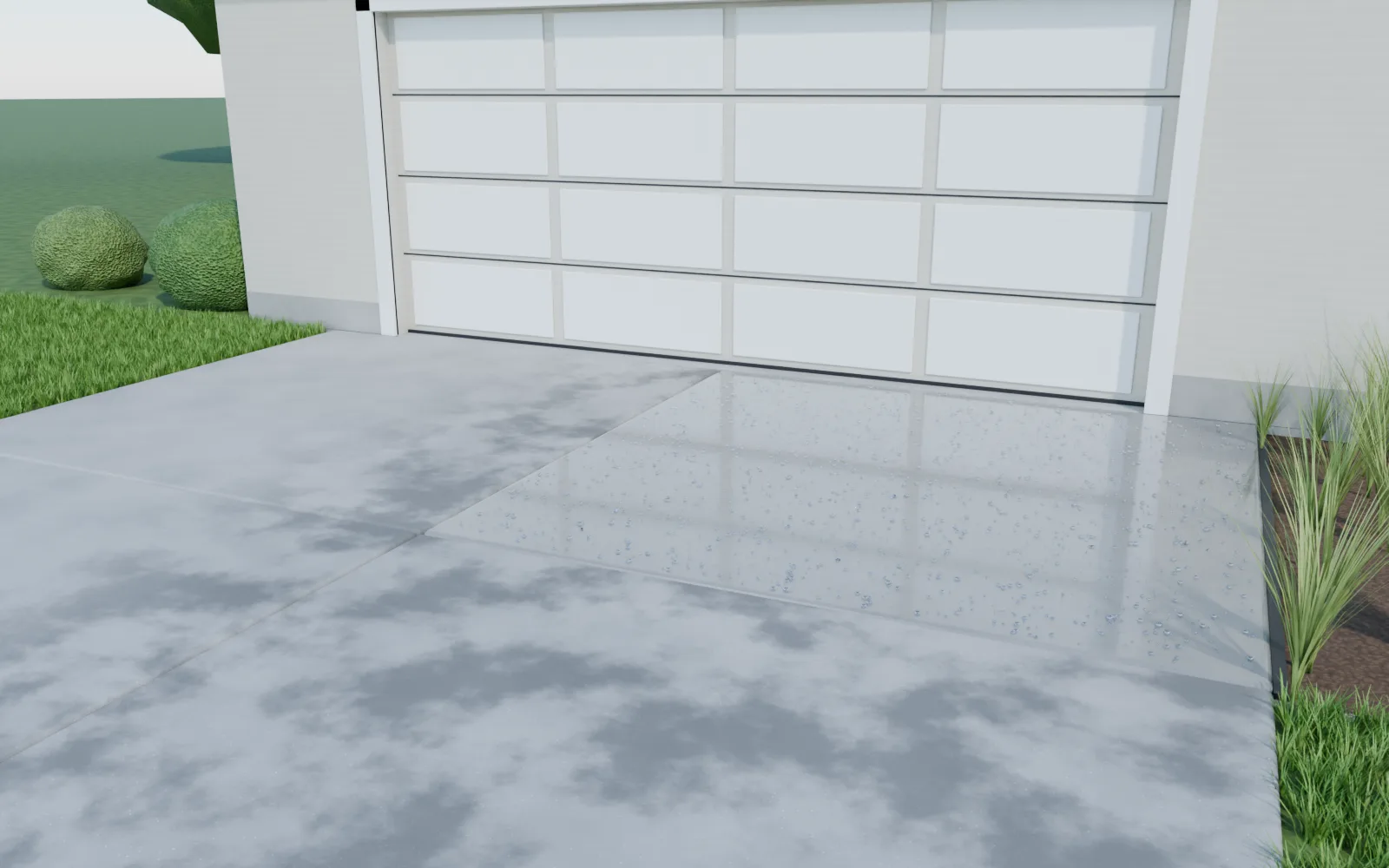
Northeast Wisconsin concrete gets road salt, freeze-thaw and snow shovels every winter. Driveway sealing slows down the damage that does: water and salt brine that soak into the surface, freeze, and pop it off in flakes. A penetrating sealer goes into the concrete instead of sitting on top, so it doesn't peel, doesn't get slick once it's dry, and barely changes the look. That's why it's the concrete sealer for driveways we use, and the price comes from your photos: concrete sealing cost depends on the square footage, how much cleaning and caulking it needs first, and access.
Concrete, not asphalt. We seal concrete driveways, walks, aprons, steps and patios, and reseal stamped and decorative concrete with a film-forming decorative sealer. The black sealcoat that goes on blacktop driveways is a different product for a different surface, and we don't do it. (Here's how the two compare.)
Sealing protects the surface. It can't close an open joint or crack, which is where most water gets under a slab, so most sealing jobs pair with crack and joint caulking. If the concrete is grimy or salt-stained, concrete cleaning comes first.
Sealing is the least dramatic thing we do. No slab rises, no stain disappears. A good sealing job looks like nothing happened, right up until the first rain, when the water beads up and runs off instead of soaking in.
Whether it works is mostly decided before the sprayer comes out: the right sealer, clean and dry concrete, and the right weather. Here's how a job runs from your first photo on.
The Process at a Glance
| Stage | What happens | What you do |
|---|---|---|
| Photos | You send pictures of the concrete | 4–6 phone photos, plus the pour date if it's new |
| Quote | We recommend a sealer type and price the job | Ask questions, say yes or no |
| Conditions | Clean if needed, then wait for dry concrete and a good forecast | Keep the concrete clear and clean |
| Sealing day | Walk-through, caulk if booked, protect, apply | Keep people, pets, and cars off |
| Aftercare | Stay off it for the label's time, then use it normally | Water-test it every spring |
Which Sealer We Use, and Where
The type of sealer matters more than anything else here. Outdoors in Wisconsin, it has to put up with road salt, freeze-thaw, and snow shovels.
| Surface | Sealer type | Why | Typical life |
|---|---|---|---|
| Driveways, walks, aprons, steps, plain patios | Penetrating (silane/siloxane) | Soaks in and makes the concrete shed water and salt brine. Breathable, no surface film, keeps its grip, barely changes the look. | Often 5–10 years, depending on sun, traffic, plowing, and salt |
| Stamped or colored patios | Film-forming decorative sealer, with an anti-skid additive | Brings back the color and sheen. We'll tell you from the photos if that's what you have, and quote it from them. | Acrylics typically last 1–3 years and can get slick when wet without a grit additive |
| Inside the garage | Not a sealer job | Epoxy, polyurethane, and polyaspartic are coatings, a separate service | See garage floor coatings |
For the deeper comparison, see concrete sealer types.
A penetrating sealer also can't soak through an old film sealer still on the surface. If your patio got a glossy coat years ago and it's peeling now, we'll tell you what it takes to get back to bare concrete first. An old film that's peeling or has gone white and hazy may need to come off before a decorative reseal, too.
It Starts With Your Photos
- The whole area, so we can size it up and see what's next to it: siding, garden beds, a wood deck, an asphalt drive.
- A close-up of the surface in good light. Smooth, broom-finished, stamped, or flaking all change the plan.
- Any shiny, peeling, or blotchy spots, which can mean an old sealer is hanging on.
- A quick water test, if you're up for it. Sprinkle water on the slab and take a photo a minute later. Beading means something is still sealing it. Darkening and soaking in means it's bare.
- The pour date, if the concrete is new.
Send them through the quote page.
Your Sealer Recommendation and Quote
From your photos we figure out:
- 1Which sealer type fits, using the table above.
- 2Whether it needs cleaning first. Almost all concrete does. Dirt and salt film keep a penetrating sealer from soaking in evenly, and a film sealer would trap whatever's under it. Our cleaning process covers that part.
- 3Whether anything should be fixed first, like a sunken slab or open joints. Sealing over a problem just gives you a sealed problem.
You get a price, what's included, and roughly how long we'll be there. If your concrete is still beading water from the last sealing, it doesn't need another coat yet, and we'll tell you so.
Waiting for the Right Conditions
This is where most sealing jobs go wrong.
| Condition | What the labels we checked call for | Why it matters |
|---|---|---|
| Clean | No dirt, oil, salt film, or peeling old sealer | The sealer has to reach the concrete's pores |
| Dry | Usually at least 24 hours after rain or washing, sometimes several days. Some allow slightly damp concrete, never standing water. | Pores full of water leave no room for sealer |
| Temperature | Usually 40°F minimum, with upper limits from about 90°F to 110°F. Some want it above 40°F for 12 to 72 hours afterward. | Outside the range, it may not soak in or cure as designed |
| Forecast | No rain for 4 to 24 hours after application, depending on the product | Rain can wash fresh sealer off or leave it spotty |
| New concrete | Cured first: 14–28 days on the products we checked, a full 28 on some | Young concrete is still drying out and gaining strength |
| Sun and wind | No hot surfaces in direct sun, no windy days | Hot slabs can dry it on top before it soaks in, and wind carries overspray |
The label on the sealer we're using is the final word on every one of these.
Before we come, keep cars, furniture, and grills off the concrete once it's been cleaned, and turn off sprinklers that hit it for the day before and the day of.
On Sealing Day
We check the slab and the forecast
We confirm the concrete is dry, the temperature and forecast fit the label, and nothing new has landed on it since cleaning. If conditions aren't right, we reschedule rather than seal a damp slab.
We caulk first, if you booked it
Joint sealant needs bare, clean, dry concrete to grip, and joint sealant makers call for surfaces free of water repellents. So the caulk goes into the joints and cracks before any sealer touches the slab, and it gets time to skin over or cure as the labels on both products require. Our caulking process explains that part.
We mask and protect
Garden beds get covered. Door thresholds, siding along the slab, and the bottom of the garage door get masked. Cars, glass, wood decking, and any asphalt next to the concrete stay out of the spray.
We apply it evenly
The sealer goes on with a low-pressure sprayer or a roller, never a drifting mist. We work in sections, keep a wet edge to avoid lap marks, and put down as much as the label says the concrete should take in.
We work out the puddles
Wherever sealer pools, in a low spot, a broom-finish groove, or a caulked joint, we back-roll or broom it out so it soaks in instead of sitting on top. If the label calls for a second coat on porous concrete, it goes on once the first has soaked in.
We close it off
We mark off the area so nobody walks or drives on it while it dries, and tell you when it's ready.
Living With Fresh Sealer
- Stay off it as long as the label says. On the penetrating sealers we checked, that ran from about 1–2 hours to 4 hours or more in mild weather, and longer when it's cool or humid. Fresh sealer can be slippery for a few hours, too. We'll give you walk and drive times for the product we used.
- Give it a few days to reach full strength. Water repellency keeps building after the surface looks dry, from about 3 days to a week on the labels we read.
- Shovel and salt like normal, but go easy. Sealer cuts down how much salt brine soaks in. It doesn't make concrete bulletproof. On concrete in its first winter, concrete industry guidance says to skip deicers and use sand for traction.
- Water-test it every spring. When water darkens the concrete and soaks in instead of beading, especially in the tire paths and where you shovel, it's time to reseal.
Sealing on a Combined Job: The Order Matters
When cleaning, lifting, caulking, and sealing are all on one job, sealing always comes last. Here's the order and why.
| Order | Step | Why it goes here |
|---|---|---|
| 1 | Clean | Everything after needs clean concrete, and a clean slab shows every crack and gap |
| 2 | Let it dry | Caulk needs dry joints, and sealer needs dry pores |
| 3 | Lift | Lifting moves slabs and opens joints. Caulk put in before a lift can tear. |
| 4 | Patch the drill holes | Patches need to be in and cured before sealer goes over them |
| 5 | Caulk joints and cracks | Joint sealant needs bare concrete, so it goes in before any water repellent |
| 6 | Seal | Last, once the caulk has skinned over or cured per both labels, with no sealer pooling in the joints |
One booking, one plan, but usually more than one trip, since drying after a wash takes at least a day and the caulk needs time before sealer goes over it. Your quote lays out the schedule. For the lifting part, see our lifting process.
What Sealing Won't Do
- It won't raise a sunken slab or get rid of a trip edge. That's a lifting job.
- It won't fill cracks or joints. Open gaps need caulk.
- It won't undo flaking or pitting already there, though keeping water and salt out can help slow more of it.
- It won't make old concrete look new. A penetrating sealer barely changes the look, which is the whole idea.
What concrete sealing costs
Sealing is $0.40–$0.90 per square foot, depending on the sealer and how much the concrete soaks up. Sealing the driveway, walks and patio together usually lands between $640–$1,000+; a single small driveway comes in under that. Cleaning comes first, and booked together it's one job. More in the concrete sealing cost guide.