
In this article (4 sections)
You're out shoveling or mowing and you spot a line in the concrete you could swear wasn't there last year. Now you're wondering if it's a big deal.
Up here, cracks come with the territory. A slab shrinks as it dries, swells and shrinks with the seasons, and sits on ground that freezes hard in January and goes soft in April. Some of the lines that leaves behind mean nothing. A few mean the ground under the slab is on the move. Below is how to read yours, starting with three quick checks and then a type-by-type guide.
Three Clues That Sort Out Almost Any Crack
Go look at your crack and answer these:
- 1Are both sides level?Run your toe or palm across it. If one side sits lower, the ground underneath has moved. That one clue changes the fix more than anything else.
- 2What's the pattern?A single line, a fine web, a crack down a joint, a broken-off corner, or curved cracks along an edge all point to different causes.
- 3Is it changing?A crack that showed up the first summer and hasn't changed in five years is a very different animal from one that's wider every spring.
Age helps too. Cracks in the first weeks or months usually trace back to the pour. Cracks that show up years later usually trace back to water, soil, or weather.
The Field Guide: 9 Common Types of Concrete Cracks
1. Plastic Shrinkage and Hairline Cracks
Looks like: Thin cracks from a few inches to several feet long, sometimes branching like a crow's foot. Both sides are flush.
Why it happens: On a hot, dry, or windy pour day, the surface loses water faster than water rises to replace it, and the top splits within hours. More hairlines can appear over the first months as the slab dries and shrinks.
Usually cosmetic. Seal any wide enough to hold water and keep an eye on the rest.
2. Crazing
Looks like: A fine web of shallow cracks forming small, irregular cells, usually an inch and a half across or smaller. Easiest to spot right after rain, when the cracks stay dark while the surface dries.
Why it happens: Finishing and curing problems: extra water in the mix, overworking the surface, or letting it dry too fast. The cracks are typically about 1/8" deep or less.
Cosmetic. Don't confuse it with flaking or pitting, which is a different problem (see what causes concrete spalling). On a garage floor, a coating covers it.
3. Control-Joint Cracks
Looks like: A crack running down the bottom of the grooves cut or tooled into the slab.
Why it happens: This is the plan working. Finishers cut grooves to give shrinking concrete a neat place to crack. A common rule of thumb is to cut about a quarter of the way into the slab and space joints no more than two to three times the slab thickness (a 4" slab gets joints roughly every 8–12 feet). When joints are too far apart, too shallow, or cut too late, the slab cracks mid-panel instead.
Not a defect. But the joint is now an open channel for water, so it's worth sealing, either yourself or as part of our concrete crack repair work. See how to fix concrete cracks and choosing a concrete crack caulk.
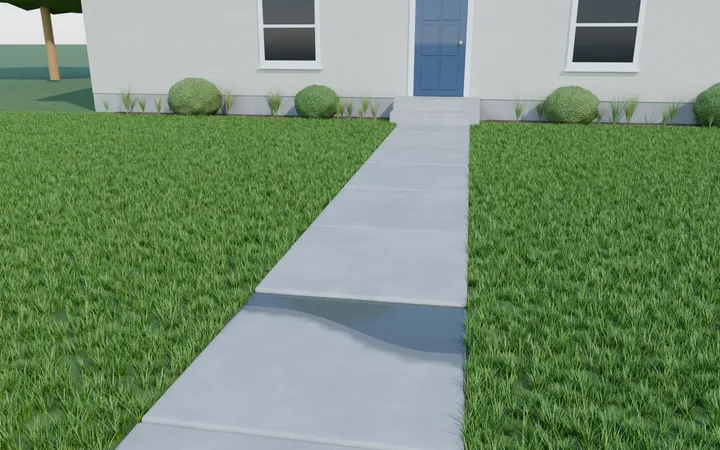
4. Settlement Cracks With Offset
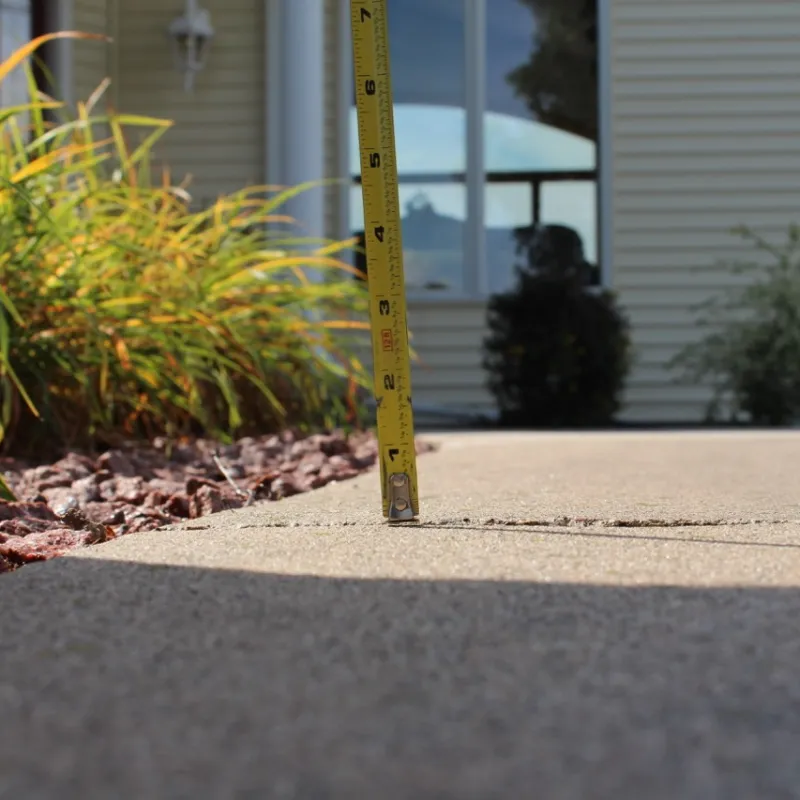
Looks like: One side sits lower than the other, and you can catch a toe on it. The slab may rock, and you might see a gap under the edge. Common spots: next to the house, at the garage approach, under downspouts, and over old utility trenches.
Why it happens: Soil under that part of the slab compacted or washed out, leaving a hollow. Around here the usual suspects are loose foundation backfill, downspouts and sump lines dumping water in one spot, and spring snowmelt. (More in voids under concrete.)
Worth fixing. It's a trip hazard, it often tips water toward your foundation, and the hollow tends to grow. The fix is lift, then seal. Caulking alone leaves both the lip and the hollow.
5. Heave Cracks
Looks like: A slab pushed up, with a crack across the high spot or a hump where it used to be flat.
Why it happens: Frost heave (wet soil freezes, expands, and shoves the slab up, usually worst in late winter) or tree roots (a slow push that only gets worse; see tree roots lifting concrete).
For frost, fix the water and watch it through a spring. If it settles back crooked, the low side can be lifted to match. No lifting method pushes a high slab down, so if it stays high, the slabs around it are lifted to meet it. A slab roots pushed up badly may need grinding or replacement.
6. Corner Breaks
Looks like: A crack cutting diagonally across a slab corner, leaving a triangle. A cousin starts at an inside corner, like the notch of an L-shaped patio, and runs outward.
Why it happens: Corners take the most stress with the least concrete around them. When soil under a corner washes out and a tire rolls over it, it snaps.
If the piece is large, still in one piece, and has dropped, it can usually be lifted and sealed. If it's shattered into chunks, that corner needs patching or replacement.
7. Freeze-Thaw Cracking
Looks like: Cracks with chipped, crumbling edges that look worse every spring, often with flaking nearby, especially where snow piles up or salty slush drips off the car.
Why it happens: Water gets into the crack, freezes, and expands by about 9%, prying it open a bit more. It thaws, more water runs in, and it freezes again. We run that cycle over and over from late fall into spring, and deicers make the surface damage worse.
Seal the crack while the edges are still solid (driveway owners, see driveway crack repair). Once the concrete is crumbling, sealant won't hold, and you're looking at patching or replacement.
8. Map Cracking and D-Cracking
Map cracking looks like: A network of connected cracks across the slab, like lines on a road map, with bigger cells than crazing. It has several possible causes, including a slow chemical reaction between certain stone and the cement, and the pattern alone won't tell you which.
D-cracking looks like: Closely spaced, crescent-shaped cracks running alongside a joint, edge, or existing crack, often starting at a corner, with dark staining around them. It's freeze-thaw damage inside the stones in the concrete: some types of stone soak up water, freeze, and break apart from within.
Tight, stable map cracking may be cosmetic. Widening map cracking and any D-cracking are problems inside the concrete itself. Sealing slows the water but can't fix the stone, and a patch only fixes the patched spot. Get a concrete contractor's opinion on replacement.
9. Structural Cracks
Looks like: Horizontal or stair-step cracks in foundation walls, foundation cracks wider than about 1/4" or still growing, or walls bowing inward.
Why it happens: Soil pressure on the walls, uneven footing settlement, or other movement in the structure.
This is a structural engineer's call, not a flatwork contractor's. Send us a photo of one and that's exactly what we'll tell you.
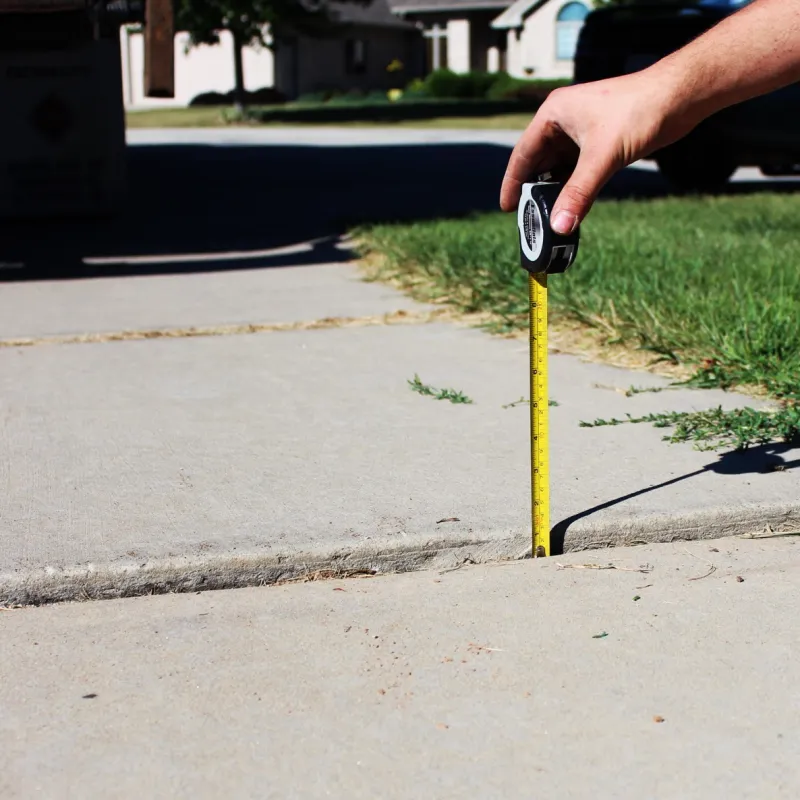
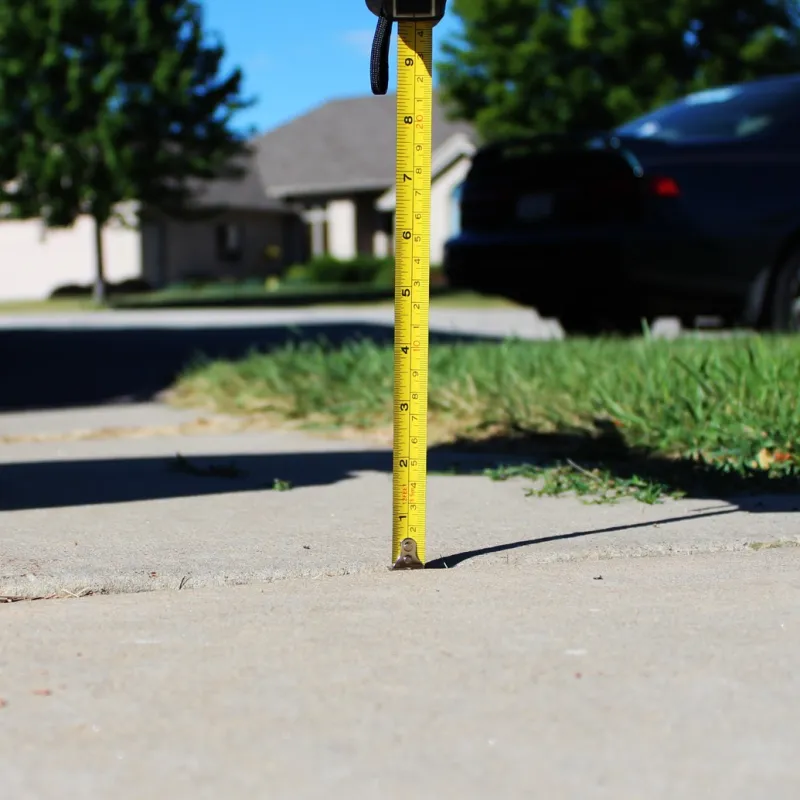
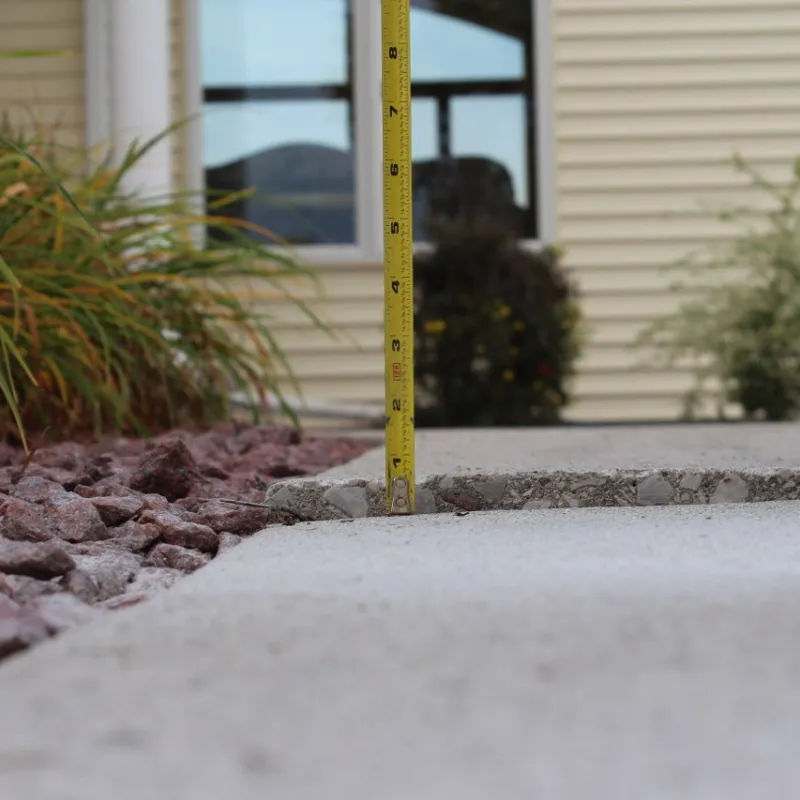
Example lifts. Photos from our own local jobs get added as we finish them.
Concrete Crack Cheat Sheet
| Crack type | What it looks like | What causes it | How worried to be | Right fix |
|---|---|---|---|---|
| Plastic shrinkage / hairline | Thin, flush, sometimes crow's-foot | Fast drying during the pour; normal shrinkage | Low | Monitor; seal if it holds water |
| Crazing | Fine, shallow web of small cells | Finishing and curing problems | Low (cosmetic) | Leave it; a coating covers it in a garage |
| Control-joint crack | Crack inside the cut groove | Normal shrinkage, right where it belongs | Low | Seal the joint |
| Settlement with offset | One side lower, trip lip, slab rocks | Soil washed out or compacted underneath | Medium | Lift, then seal |
| Heave | Slab pushed up, hump at the high point | Frost heave or tree roots | Medium | Fix the water and monitor; lift the low side or replace |
| Corner break | Triangle cracked off a corner | Weak support plus loads | Medium | Lift then seal if intact; patch or replace if shattered |
| Freeze-thaw | Chipped, crumbling edges, worse each spring | Water freezing in the crack; deicers | Medium to high | Seal early; patch or replace once crumbling |
| Map cracking | Road-map network across the slab | Several causes, some inside the concrete | Low to high | Monitor; get it diagnosed if widening |
| D-cracking | Curved cracks along joints, dark staining | Freeze-thaw damage inside the stone | High | Patch short term; replace long term |
| Structural | Foundation wall crack: horizontal, stair-step, wide, or growing | Foundation or soil movement | High | Call a structural engineer |
Where We Fit (and Where We Don't)
- Joint and crack caulking. We seal control joints, expansion joints, cracks, and the gap where your slab meets the house, often right after a lift. (That house gap gets its own post: caulking where concrete meets the house.)
- Foam lifting for settlement cracks, dropped corners, and anything with an offset. A few dime-sized (5/8") holes, a lightweight structural foam that fills the hollow and raises the slab in small increments, then the holes get patched.
- Garage floor coatings, with crack filling and repair as part of the prep.
What we don't do: replace crumbling or D-cracked concrete, or fix foundations. For those you want a concrete contractor or a structural engineer.