
In this article (5 sections)
Getting concrete to rise is the simple half of the job. Getting it to stop at the right spot, and stay in one piece on the way there, is the half that takes judgment.
A slab lifted 3/8" too high is a brand-new trip edge. A garage apron lifted dead level now sends snowmelt toward your garage door. A slab pushed too hard in one spot cracks right in front of you. None of those can be undone by pumping in more foam.
Everything below applies to any lift, foam or otherwise: what tends to go wrong, what a careful crew does differently, and how to tell before you hire someone which kind you're getting. It's also how we approach our own concrete leveling work.
Two Facts About Concrete That Make Lifting Tricky
Everything else in this article comes back to these:
- 1Lifting only goes one wayFoam, mudjack slurry, and stone grout can all raise a slab. None of them can lower it. Overshoot, and the options are grinding, living with it, or replacing the slab.
- 2Concrete is strong one way and weak the otherA slab can carry a lot of weight pressing down on it when it's evenly supported. Push hard on one spot from below while the rest of it is sitting on solid ground or hung up on a neighbor, and it bends. Concrete doesn't bend much before it snaps.
So every good lift is a balancing act: enough material to support and raise the slab, spread out enough that no one spot takes all the force, and stopped at the right moment.
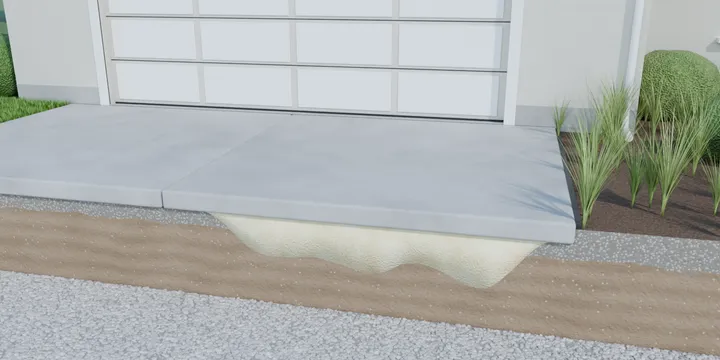
The method plays a part too. Mudjacking pushes a heavy slurry (about 100 to 150 pounds per cubic foot) through holes about 1 1/2 to 2 inches across, which makes that kind of fine control harder than it is with foam through dime-size holes.
Five Ways a Lift Goes Wrong
| What goes wrong | What you'd see | What causes it | How it's prevented |
|---|---|---|---|
| Over-lifting | Slab now sits higher than its neighbor, or water runs the wrong way | Too much material in one shot, or no clear target height | Small shots, a reference line, stopping just short |
| Cracking the slab | New crack during or right after the lift | Raising one spot too far, too fast, while the rest is stuck | Rotating between holes, freeing tight joints first |
| Lifting the wrong way | Slab is "level" but drains toward the house or garage | Aiming for flat instead of the right pitch | Agreeing on the finished slope before drilling |
| Hidden voids left behind | Slab looks right, then rocks or sounds hollow months later | Material lifted the slab near the hole before spreading under the rest | Filling voids first, holes placed where the gaps are |
| Dragging a neighbor | Chipped joint edges, a neighboring slab tipped up, a stoop jammed into the door threshold | Slab bound against another slab, the house, or packed debris | Cleaning out joints and watching every joint during the lift |
A few of these deserve a closer look.
Over-lifting
Foam keeps expanding for a short time after the trigger is released. An installer who injects until the slab hits the target will end up above it. The careful approach is to stop a little early and let the last bit of expansion finish the job.
Hidden voids
Picture a patio slab with a downspout at one corner. That corner is washed out three inches deep, and the far side still sits on firm clay. Inject through one hole in the middle and the foam can start pushing up near the hole before it ever reaches the washout. From the patio door it looks great. Underneath, one corner is hanging in the air, and next spring that's the corner that rocks or snaps off. Hole placement and patience get material into the low corner first.
Lifting the wrong way
"Level" isn't always the goal. A patio should fall away from the house, and a garage apron has to meet the garage floor and still drain away from the door. Get it wrong in Green Bay and you'll have water at the foundation in spring and ice at the garage door in January. The reference matters too: matching a slab to a neighbor that's sitting high on frozen ground in March leaves it too high once the frost comes out.


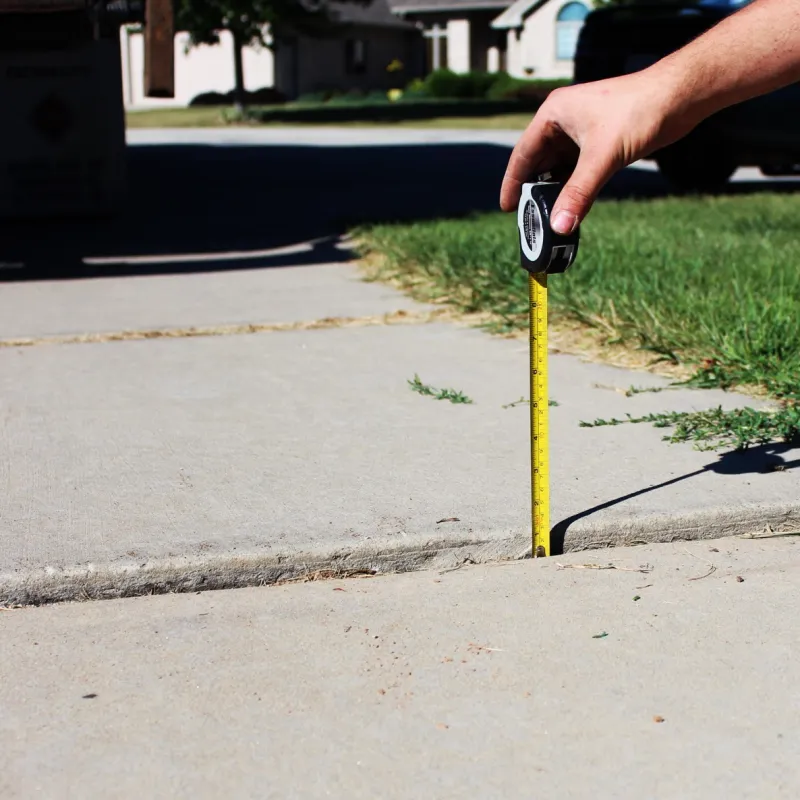
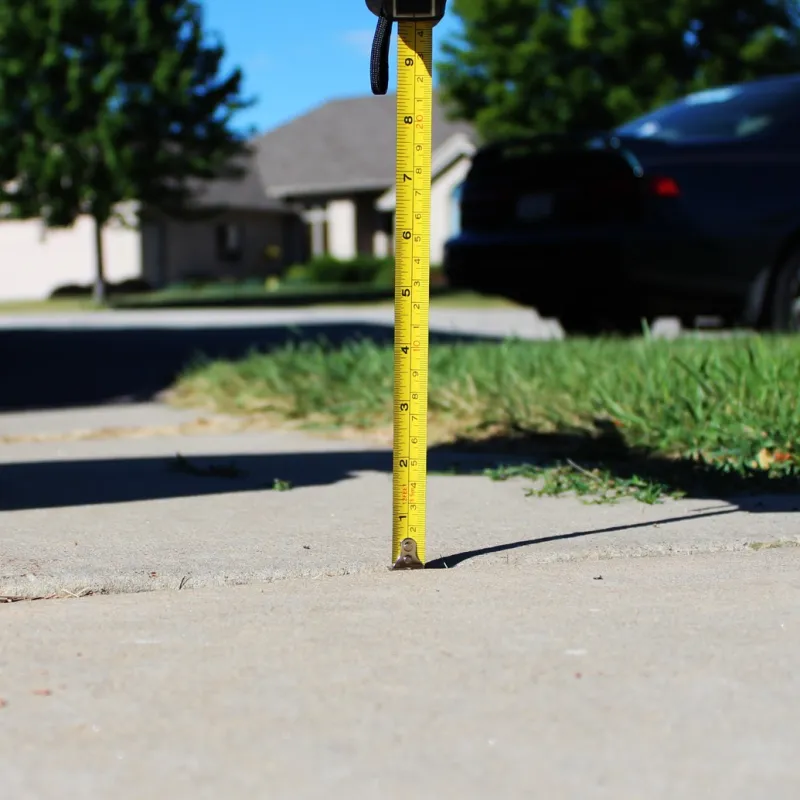
Example lifts. Photos from our own local jobs get added as we finish them.
What Control Actually Looks Like on Site
You don't need to know how to run the equipment to spot these. You just need to know what to look for.
- A reference you can see. String lines pulled tight across the slabs, a long straightedge, a level, or a laser. Something that shows the target height, not just the installer's eye. A gauge block or tape between the string and the slab shows exactly how far is left to go.
- Small, repeated injections. The American Concrete Institute's field guide to slabjacking calls for raising any one spot no more than about 1/4" at a time to avoid cracking. Good installers work a slab up in rounds, moving from hole to hole, not by pumping one hole until the slab jumps.
- Holes placed with a reason. Holes go where support is missing and where the slab needs to move most, spaced so material can reach the whole void. Holes jammed right against an edge or joint can let material escape out the side instead of lifting.
- A sensible order. Fill the empty spaces first, then lift. Work the low side and leave alone the side that's already right. On a run of slabs, lift in a sequence so each one is supported by the next instead of fighting it.
- Eyes on the joints. Movement shows up first at joints and existing cracks. Some crews put a strip of tape across a joint so they can see it start to open or pinch. If a joint starts closing hard, or the neighboring slab starts moving with this one, the lift stops until the reason is clear.
- Freeing the slab before lifting it. Gravel, dirt, and old caulk packed into a joint can lock two slabs together. Cleaning it out lets the slab rise on its own.
- Knowing what's underneath. Material moves into open space, including buried downspout pipes, drain lines, and gaps along the foundation. A careful contractor asks about these before drilling and notices when a slab suddenly stops responding.
- Willingness to stop. If a slab is pinned under siding or wedged against a step, the careful move is to stop and talk about it, not push harder.
If you want to see how these fit into a full job from start to finish, that's covered in Our Concrete Lifting Process.
Questions to Ask Any Concrete Lifting Contractor
These work whether you hire us or someone else. You're not trying to trip anyone up. You're listening for whether they've thought about it.
| Ask this | A careful answer sounds like | A red flag sounds like |
|---|---|---|
| "What height are you aiming for, and how will you check it?" | A specific target (flush with the next slab, a set pitch away from the house) and a tool: string line, straightedge, level, or laser | "We'll get it level," with no mention of how |
| "How much do you raise it at a time?" | Small amounts, moving between holes | "We just fill it till it comes up" |
| "Where will the holes go, and why there?" | Tied to where the slab dropped and where the gaps are | "Same pattern every time" |
| "What if a slab is stuck against the house or another slab?" | Clean out the joint first, and stop if it still won't move cleanly | "It'll pop loose" |
| "How do you make sure there aren't hollow spots left?" | Fill voids before lifting, check by tapping or by how the slab responds | No answer, or "the foam takes care of it" |
| "Is there anything under or near my slab you need to know about?" | They ask about drain lines, sump discharge, and buried pipes before you bring it up | They never ask |
| "What made it sink, and what should I fix?" | Names a likely cause (downspout, washout, grading) and tells you what to change | "It just settles" |
| "Is there any of this you wouldn't lift?" | Points out slabs that are too broken, root-heaved, or pinned to lift well | Says yes to every slab without hesitation |
Notice the last one. A contractor who tells you not to lift something is showing you how careful they'll be with the slabs they do lift.
Check the Work Yourself Afterward
You can check the finished lift in five minutes:
- 1Lay a straightedge across each jointA 4-foot level works. You shouldn't feel a lip with your toe or see daylight under the straightedge where slabs are supposed to be flush.
- 2Run a garden hoseWater should run away from the house, the garage door, and the stoop, not pool against them.
- 3Tap around with a hammer handleA solid knock is good. A hollow sound in one area is worth pointing out.
- 4Look for new cracksCompare to your "before" photos. Old cracks will still be there. A fresh, clean crack is worth a conversation.
- 5Check the neighborsThe slabs on either side, the stoop, and the door threshold should be where they were, with no chipped joint edges.