
In this article (10 sections)
A slab that sits lower than it used to, whether it's the sidewalk square by the front steps, the driveway section the snowblower catches, or the patio tipping rain at the foundation, is a lifting job more often than not. Every contractor you read will push a different method, so here is the plain version: what's going on under the slab, the four ways to fix it, how foam does the lift (the 3D cutaway below shows it), what it costs around Green Bay, and how to rule yours in or out before anyone drills. If you'd rather skip to having it done, our concrete leveling in Green Bay page has the prices and the warranty.
In Green Bay or Northeast Wisconsin? Get a firm price from photos. Send three photos of the slab and we'll text you a price for the lift. How we do it, what it costs and what the warranty covers is on our concrete leveling page.
The Whole Idea in One Paragraph
Your concrete didn't shrink. The ground under it did. Soil washed out, packed down, or got shoved around by frost, leaving a gap or soft spot where solid support used to be, and the slab tipped into it. Every lifting method does the same basic thing: put new material into that space until the slab is supported again, then keep going until it's back where it belongs. The methods differ in the material, the hole size, the weight of the fill, and how soon you can use the slab again.
On the names: lifting, leveling, concrete raising, and slabjacking are general terms, and some folks call it cement lifting. Mudjacking, polyjacking (foam), and stone slurry grout are specific methods, compared below.
Why Concrete Sinks in Northeast Wisconsin
Around Green Bay, it usually comes down to some mix of these:
- Loose backfill next to the house. The strip of soil along your foundation was dug out and refilled when the house was built, and it keeps compacting for years. Stoops, patios, and walks along the house sit right on it.
- Heavy clay. Much of the Fox River valley sits on dense red clay left behind by glaciers. Clay holds water and drains slowly, so the ground under your slab stays soggy longer after every rain and every thaw.
- Frost heave and spring melt. When wet, fine-grained soil freezes, ice builds up in layers and pushes the ground up, slab and all. Clay and silt are the worst for it. In spring the ice melts, a winter's worth of snowmelt soaks in, and the slab settles back, often lower or more crooked than it started.
- Downspouts and sump discharge. A downspout or sump line that dumps next to a slab washes fine soil out from under its edge, a little more with every storm.
- A poorly packed base. Gravel that wasn't compacted well keeps settling long after the concrete truck leaves.
- Rotting roots and buried debris. Old stumps, roots from a removed tree, and construction scraps in the fill break down and leave voids. (More on that in our guide to tree roots and concrete.)
One thing that doesn't sink concrete: road salt. Deicers plus freeze-thaw can make the surface flake and pit (called scaling), but that's surface damage, not settling, and lifting won't fix it.
The Four Ways to Fix a Sunken Slab, Compared
Three of these lift the slab you already have. The fourth throws it away and starts over.
| Polyurethane foam | Mudjacking | Stone slurry grout | Tear out and replace | |
|---|---|---|---|---|
| What goes under | Two liquids that expand into rigid foam | Pumped slurry of soil or sand, cement, and water | Pumped slurry of crushed limestone and water, sometimes with cement | New base and new concrete |
| Hole size | 5/8" (about a dime) | Typically 1–2" | About 1" | n/a, the slab is removed |
| Weight of the fill | A few pounds per cubic foot | In the neighborhood of 100 lb per cubic foot | Heavy (it's stone and water) | n/a |
| Back in use | Walk right away, drive the same day | Usually a day or more | Varies with the mix, so ask | Walk in about a day, drive in about a week, full cure in about a month |
| Washout risk | Waterproof once cured | Can erode if water gets under it | Can erode if the mix is light on cement | Depends on the new base |
| Mess | Minimal | Bigger holes, more cleanup | More cleanup than foam, pumped from a truck | Demolition, hauling, torn-up edges |
| Fixes broken concrete? | No | No | No | Yes |
| Relative cost | Usually more than mudjacking | Usually less than foam | Varies by contractor | Usually the most |
To be fair to the other options: mudjacking works and usually costs less than foam, but it means bigger holes and a heavy fill on soil that already failed once. Stone slurry is in between on hole size, but it's still a heavy, water-based fill. Replacement is the right call when the concrete itself is shot, though new concrete poured on the same soggy ground can settle too if nobody fixes the water.
We chose foam because it's light, uses small holes, won't wash out, and gives you your driveway back the same day. It's the only lifting method we offer, and if a different fix suits your slab better, we'll say so. More on the trade-offs in our foam lifting pros and cons.
Mudjacking vs. Foam: Same Idea, Different Fill
Mudjacking is the name most people know, and plenty of folks use it for any slab lifting. It does the same job as foam, filling the space under the slab and pushing it up, but with a heavy slurry through bigger holes, and the slab usually needs a day or more before it carries a car. Foam is the modern version of mudjacking: dime-size holes, a fill that weighs a few pounds per cubic foot, and you can drive on it the same day. Our foam vs. mudjacking guide goes through every trade-off.
Seven Jobs Lifting Won't Do
Before the how, here's where foam stops working, so you can rule your slab out early.
- A heaved slab stays heaved. No lifting method pushes concrete down. If roots shoved a slab up, the most we can do is bring the slabs around it up to ease the edge. If frost did, that's fine to send in: after the thaw, we look at lifting the slabs around it to meet it.
- A slab in rubble stays rubble. A slab in one or two big pieces can usually be raised. One that's broken into a dozen chunks, or crumbling along the edges, is a replacement job.
- The surface looks the same afterward. Scaling, pitting, and spalling ride along with the slab and are still there when it's level.
- The water keeps doing its thing. If a downspout keeps soaking the same corner, the soil around the foam can keep washing away.
- A pinned slab may not budge. Concrete tucked under siding or wedged against another slab can bind. Sometimes clearing the joint frees it. Sometimes pushing harder just cracks something.
- Basement walls aren't flatwork. Cracking or bowing foundation walls need a foundation specialist. Slab lifting is for driveways, walks, patios, and floors.
- Pavers and flagstone get reset instead. They're loose pieces, so the fix is pulling them up and re-leveling the base.
One Wisconsin timing note: a slab that only looks off in late winter may be frost-heaved, not sunk. Wait until the ground thaws before you judge it.
How Foam Actually Raises a Slab
- 1Two liquids meet at the gunThey're pumped separately through a 5/8" hole and mix as they go in. Within seconds, the mix starts expanding.
- 2It fills the gaps firstExpanding foam takes the easy path, so it spreads into voids, washouts, and soft spots.
- 3Then it liftsOnce the space underneath is full, the only direction left is up. The slab rises.
- 4Small shots, many timesThe installer injects a little at a time, moving between holes and checking the slab, until it's where it should be.
- 5It hardens into a light, waterproof baseThe holes get patched and the slab is ready for foot traffic right away.
Step 4 is where the skill lives. We wrote a separate guide on what control looks like and how to judge it: Precise Concrete Leveling.
3D render, not a job video. It's a generic example, a driveway slab that sank at the garage door; the steps are the same on any slab. The ground is cut away so you can see under the slab; nothing is dug on a real job. Simplified to four ports; a real 10 by 10 foot section usually gets six to ten. The foam's weight, strength and set time, with sources, are in how foam lifting works.
Transcript: what the video shows (23 seconds, no sound)
- 1. Set the line. A laser line off the slab that didn't move shows how far the low one has to come up. This one sank about 2″, a little more at the corner.On screen: About 2″ low; Laser line = target; Empty space under the slab.
- 2. Drill and set the ports. 5/8″ holes, kept in from the edges, then a plastic injection port tapped into each one so the gun can lock on.On screen: Injection ports.
- 3. Pump the foam. Two liquids travel down separate hoses and mix in the gun. They go in through the first port and run to the lowest spots.On screen: Liquid runs to the low spots.
- 4. Expand and fill. Within seconds the mix expands 15 to 22 times its liquid volume and fills most of the space from that port. The next port fills the rest, pressing loose soil tight.On screen: Expands from the first port; Second port fills the rest.
- 5. Lift to the line. Once the space is full, short shots, port to port, raise the slab evenly. We stop when it meets the line.On screen: Short shots, port to port; Back on the line.
- 6. Patch and caulk. The ports come out, each hole is packed with grout and troweled flush, and the joint at the garage gets a bead of flexible sealant.On screen: Garage joint caulked.
What Happens on Lifting Day
The short version: we figure out what sank the slab, drill, lift in small steps, patch, and clean up. Most residential walks take a couple of hours. For the full step-by-step, from your first photo to what to do after, read Our Concrete Lifting Process.
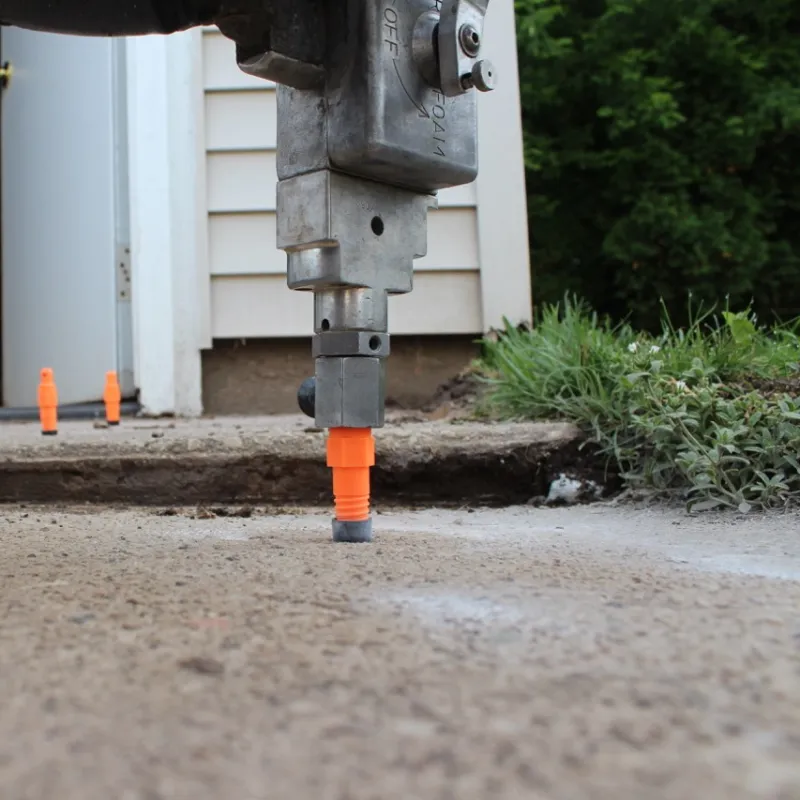
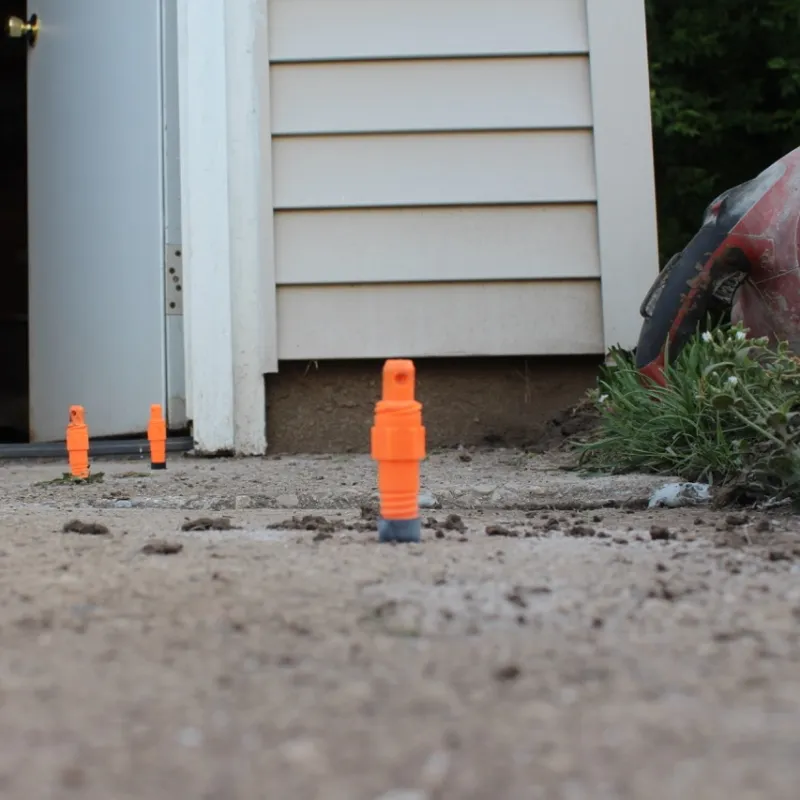
Example lifts. Photos from our own local jobs get added as we finish them.
Where Around the House Foam Lifting Fits
| Area | Usually a good candidate? | What to watch for |
|---|---|---|
| Sidewalks and walkways | Yes | Usually the quickest jobs |
| Driveway slabs | Yes | Water still has to drain toward the street, not the garage |
| Garage apron | Yes | Has to meet the garage floor and shed water away from the door |
| Garage floor | Often | Floor drains, posts, and how the slab meets the walls all shape the plan |
| Patios | Yes | Should pitch away from the house when finished |
| Front stoops and steps | Often | Some are hollow or tied into the foundation, so they need a closer look |
| AC and heat pump pads | Yes | Refrigerant lines need slack first (see our AC pad guide) |
Quick Self-Check: Is This a Lifting Job?
- 1Is it lower than its neighbor, not higher?Lower is a lifting job. Higher is a different conversation.
- 2Is it in one piece, or a few big pieces?Either is fine. Lots of small pieces means replacement.
- 3Does it rock, or sound hollow when you tap it with a hammer handle?That's a void, and foam fills voids.
- 4Can you see where the water comes from?A washed-out edge or a downspout nearby is half the diagnosis.
- 5Is the surface solid?Flaking and crumbling won't go away after a lift.
Yes to 1, 2, and 5 means there's a very good chance it's a lifting job. Photos will confirm it.
Concrete Lifting in Green Bay: Cost, Timing, Who Does It
What it costs. Our lifting jobs start at a $300 minimum, and on average land between $4 and $10 per square foot, set by how far the slab has sunk, the void under it and its size. On average that's about half of what tear-out and replacement runs around Green Bay. A single sidewalk panel or AC pad is usually $300–$600, a garage apron $400–$1,000, a patio $600–$1,500. The full sheet, with what moves a job up or down, is on our concrete leveling cost page.
When it happens. Lifting runs from the spring thaw, usually late April, until the ground freezes in November. Photo quotes are answered all winter, so a slab you notice in January can have a firm price and a spot at the front of the spring schedule before the frost is out.
What you're buying. Every lift carries a 5-year re-lift warranty, the holes are 5/8 inch and patched flush, and you deal with the owner from the first photo to the finished slab. Our concrete leveling service covers every surface we lift, and the town pages for Green Bay, De Pere, Howard, Suamico, Ashwaubenon, Bellevue and Allouez cover what's different about the ground in each.