
In this article (5 sections)
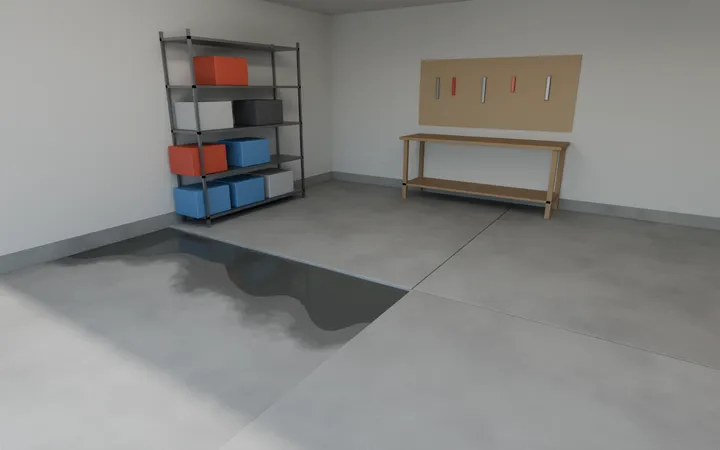
Your garage has a low corner where meltwater collects. Or the patio tips toward the house. Or there's a dip in the basement where the old furnace sat. Somebody tells you to grab a few bags of self-leveler and be done by lunch.
Sometimes that works. More often, people find out six months later that the product did exactly what it was designed to do, and that wasn't what their floor needed.
Here's what self-leveling concrete actually is, how it goes wrong, and how it stacks up against lifting and coatings.
What Self-Leveling Concrete Actually Is
Despite the name, it isn't regular concrete. Most are cement-based mixes with additives that make them runny enough to flow out and settle flat by gravity. You mix it with water, pour it, spread it a bit, and it levels itself.
A few things are true of most self-leveling underlayments on the market:
- It's an underlayment, not a finished floor. Most are made to be covered by tile, vinyl, wood, or carpet. Many manufacturers say plainly that their product isn't meant to be a wear surface.
- It's for interior use. Common products are labeled for interior, dry areas only.
- It goes on thin. Depending on the product, the range is roughly 1/8" up to an inch or two per pour. A few products allow thicker pours with added gravel.
- It has a short window. Many products stay fluid for only around 10–25 minutes after mixing. Then you're done whether the floor is or not.
- It needs prep. Clean, sound concrete, mechanically roughened, then primed. Skip any of those and the bond suffers.
There are specialty toppings rated for exterior use and freeze-thaw. They're a different product category, they still need careful prep, and they're usually a pro install.
Where It Goes Wrong
It rides along on a sinking slab
This is the big one. If your slab sank because the soil underneath compressed or washed out, the void is still there after you pour an overlay on top. You've made the surface flat for now, but the slab under it keeps doing whatever it was doing.
A slab that's still settling takes the overlay with it. Now you have a sunken slab with a thin, cracked layer of overlay stuck to it. That's why lifting comes first. In a garage, foam garage floor leveling raises the slab and fills the void, and then you can decide whether the surface still needs anything.
It lets go of a dirty or slick floor
Self-leveler bonds to clean, porous, roughened concrete. Common bond breakers on old floors:
- Paint, sealers, and old coatings
- Oil and grease (every garage floor has some)
- Curing compounds left on newer slabs
- Dust from inadequate vacuuming
- A smooth, troweled surface that was never roughened
Manufacturers generally call for mechanical prep (grinding or shot blasting) to remove contaminants and open up the surface, and many specifically say not to rely on acid etching or chemical strippers. When the bond fails, the overlay sounds hollow when you tap it, then cracks and lifts in sheets.
Primer gets skipped or rushed
Primer isn't optional on most of these products. It seals porous concrete and helps the overlay bond. Manufacturers typically want it fully dry before you pour. Skipping it, or pouring over wet primer, invites a weak bond and an overlay that lets go later.
The mix is off
Too much water makes it flow beautifully and cure weak. Over-mixing, a cold room, or a hot, drafty room can all lead to cracking or a surface that dusts. Most products also want both the air and the slab above a minimum temperature (often 41–50°F) while it cures, which rules out a cold Wisconsin garage for a good chunk of the year.
Old cracks and joints reappear
Self-leveler is rigid. If the slab under it has a crack or joint that moves, that movement shows up in the overlay. Manufacturers' instructions generally say moving joints have to be carried up through the overlay and the flooring, not poured over. Even dormant cracks that get pre-filled can still telegraph through. Pour over a moving crack and you'll see it again.
Wisconsin winters pry it loose
Put a thin cement layer outside in northeast Wisconsin and it faces freeze-thaw cycles, spring snowmelt soaking in, and road salt tracked onto it all winter. Water gets into any weak bond line or hairline crack, freezes, and pries the overlay off. Salt makes freeze-thaw damage worse. An interior-rated self-leveler on a patio, walk, or apron isn't built for any of that, and it's unlikely to last.
Self-Leveling vs. Lifting vs. Coating
| Self-leveling overlay | Foam concrete lifting | Garage floor coating | |
|---|---|---|---|
| What it changes | The surface height, by adding material on top | The slab's position, by raising it from underneath | The surface, by sealing and finishing it |
| Fixes a sunken slab? | No. Hides the dip; the void stays | Yes. Raises the slab and fills the voids under it | No |
| Indoor or outdoor | Mostly interior | Indoor and outdoor slabs | Garage floors |
| Handles freeze-thaw? | Typical bagged products aren't made for it | Foam is waterproof once cured and won't wash out | Protects the surface from salt brine and meltwater |
| Finished surface? | No, usually needs flooring on top | No, it's your same concrete, just level | Yes, that's the point |
| Downtime | Hours to a day or more before flooring goes on | Walk on it right away; drive on it the same day | Depends on the system |
| Best for | Flattening a stable interior floor before new flooring | Sunken walks, driveways, patios, aprons, garage slabs | Protecting and finishing a stable garage floor |
The short version: lifting fixes where the slab sits. A coating protects the top of it. Self-leveler flattens the surface of a floor that's already stable. They solve different problems, and on some floors you need two of them in the right order.
Which Problem Do You Actually Have? A Quick Self-Check
- 1Is the low spot inside or outside?Outside (patio, walk, driveway, apron): skip the self-leveler.
- 2Is there a crack with one side lower than the other?That's settling. The slab needs to come up, not get covered.
- 3Does the slab rock or sound hollow when you tap it?There's a void underneath. Lifting fills voids. Overlays bridge over them.
- 4Has it gotten worse in the last couple of years?Then it's still moving. Fix the movement first.
- 5Is the dip in a garage you'd like to coat?Lift the low section first, then repair cracks and put down the garage floor coating. Self-leveler under a garage coating is a specialty job that has to use a product rated for it.
- 6Is the floor stable and you're putting down tile or plank?Self-leveler is probably exactly right.
Where Self-Leveler Earns Its Keep
It isn't a bad product. It's a specific one. It's the right tool when:
- You're installing a new floor covering indoors. Tile, vinyl plank, and engineered wood all want a flat substrate. Self-leveler is how flooring installers get there.
- The slab is stable. The dips are old and done moving: a low spot from the original pour, an area where a wall or appliance used to be.
- The surface just needs smoothing. Patched areas, uneven transitions, old adhesive residue (handled correctly; old cutback adhesive may contain asbestos and shouldn't be sanded or ground).
- Someone does the prep right. Grinding, vacuuming, primer, temperature control.
If that's your project, it's a good choice, and you don't need a lifting contractor for it. A flooring installer is the right call.