
In this article (8 sections)
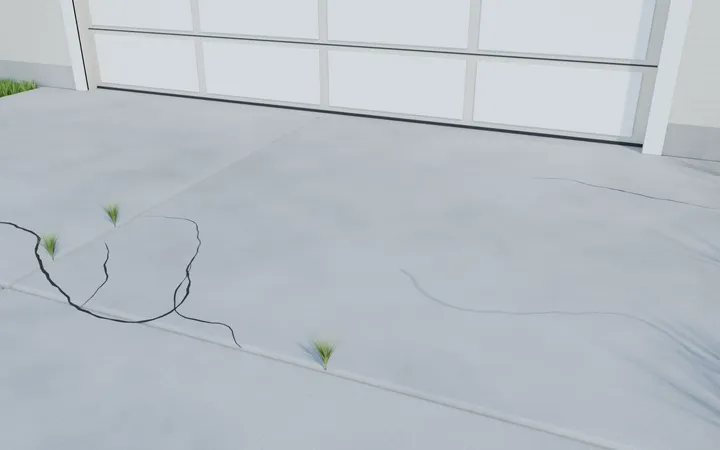
The old driveway looks tired. The patio is pitted from years of salt. The garage floor has a dip by the door. Tearing it all out sounds expensive and messy, so the obvious question comes up: why not pour new concrete right on top?
Sometimes that's a smart move. Sometimes it's money spent burying a problem that shows up again by spring.
The difference almost always comes down to the slab underneath, not the product on top.
Three Ways to Put New Concrete Over Old
"Pouring over" covers three very different products. Based on manufacturer data sheets and industry guidance:
| Type | Typical thickness | Where it's used | What it depends on |
|---|---|---|---|
| Bonded resurfacer | Feather edge up to about 1/2" for common bagged products | Worn driveways, walks, patios, floors | A clean, roughened, dampened surface it can grip, plus the right temperature |
| Self-leveling underlayment | Roughly 1/8" to an inch or two per pour; some allow more with pea gravel | Mostly indoor floors, under tile, plank, or carpet | Primer, a stable slab, and flooring on top (most aren't a wear surface) |
| Unbonded topping | At least 4" (the American Concrete Institute's recommended minimum), often more | Capping a slab that's structurally sound but badly worn | A bond breaker such as plastic sheeting between layers, and room for the added height |
Resurfacers are glued to the old slab, so whatever the slab does, they do too. Self-leveler is mostly an indoor flooring product, and we cover its limits in self-leveling concrete problems. An unbonded topping is really a new slab that uses the old one as its base; outside, it should be an air-entrained exterior mix like any Wisconsin driveway. Thicker bonded toppings exist too, and they follow the same rule as resurfacers.
The Old Slab Gets the Final Say
Every overlay inherits whatever the slab under it is doing.
A bonded overlay moves when the slab moves, so a crack that opens in winter opens in the overlay too. One resurfacer maker's data sheet says plainly that reflective cracking can't be completely prevented. Industry guidance says active cracks have to be stabilized before a topping goes on, and joints in the overlay should sit over the joints in the old slab.
An unbonded topping floats on the old slab, but it still rests on whatever support that slab has. If the soil underneath washed out, the new slab sits over the same hole.
First, sort out which kind of problem you have. Surface problems (scaling, pitting, stains, worn paste, small cracks that aren't moving) are what overlays are built for. Position problems (sinking, rocking, heaving, tipping toward the house) aren't. A slab that sank is a job for concrete raising, not an overlay.
Situation by Situation: Overlay or Something Else?
| Your slab | Overlay a good idea? | Better fix, or what to do first |
|---|---|---|
| Sound and level outside, with surface scaling or worn paste | ✅ Can be, with careful prep and the right weather | A bonded resurfacer from a concrete contractor; or clean and seal if the wear is light |
| Stable indoor floor, uneven, getting new flooring | ✅ Yes | A flooring installer with self-leveling underlayment |
| Stable garage floor, pitted or stained | ⚠️ Possible | A garage floor coating, with crack repair in the prep, is usually the better fit |
| One slab sunk below its neighbor | ❌ No | Lift it, then decide whether the surface needs anything |
| Rocks underfoot or sounds hollow | ❌ No | Fill the void underneath; foam fills voids as it lifts |
| Crack with one side higher than the other | ❌ No | Lift the low side, then seal the crack |
| Crack that opens and closes with the seasons | ⚠️ Only if it's carried up through the overlay as a joint | Flexible joint sealant |
| Pushed up by frost or tree roots | ❌ No | Deal with the cause. Frost: lift the neighbors to meet it, after the thaw. Roots: grind, lift the neighbors, or replace |
| Broken into pieces or crumbling deep | ❌ Not a thin overlay | Replacement, or an unbonded topping if the base is stable and there's room for the height |
| Pitched toward the house | ❌ Rarely | Lift it so it pitches away again |
Height: The Problem Nobody Measures
Every overlay adds height. A resurfacer adds a little. An unbonded topping adds at least 4 inches. Before anyone pours, check everywhere the slab meets something else:
- Doors. Raise a stoop toward the threshold and snowmelt can run under the door, or a storm door may stop clearing. Raise a garage floor and the overhead door may need adjusting.
- Steps. Building up the walk at the bottom of a stairway shortens that first step. The International Residential Code, a national model code, limits the difference between the tallest and shortest riser in a flight to 3/8 inch, because an odd-height step trips people.
- Siding. The same model code expects wood siding and framing to sit at least 2 inches above a patio or porch slab unless the wood is rot-resistant or treated.
- Drainage. The new surface still has to pitch away from the house. On a slab that tips toward the foundation, the low end is against the house, right where there's the least room to add height.
Why Thin Overlays Have a Hard Life Outside in Wisconsin
- Water finds the bond line. Anywhere the overlay isn't fully stuck down, water gets under it, freezes, expands, and pries it up. That's where patchy peeling comes from.
- Salt makes freeze-thaw worse. Driveways and walks get deicers all winter, and the damage concentrates at the surface, which is exactly where a thin overlay lives. Our guide to why concrete flakes explains the mechanics.
- The season is short. Resurfacer data sheets we checked list minimum air and surface temperatures around 45–50°F, call for moist curing, and want the work protected from rain and frost. In northeast Wisconsin, that rules out a good share of the year.
- Joints have to stay joints. Control and expansion joints have to be carried up through the overlay. Cover them and the overlay cracks along them anyway.
Outdoor resurfacing can work, but only on the right slab, with real prep, in the right weather.
Overlaying a Sunken Slab Just Buries the Sinking
A slab doesn't sink because its surface wore out. It sinks because the soil under it compressed or washed out, usually from downspouts, sump discharge, or loose backfill along the foundation. Pour on top of it and:
- the void is still there, and still growing if water still gets in
- a resurfacer can't make up the drop anyway, since common products top out around 1/2 inch and a sunken slab is often down an inch or more
- a thick topping piles more weight onto soil that already couldn't hold the slab
- the overlay rides down with the slab and cracks where it meets the higher slab next door
The order is: fix the water, lift the slab, then decide whether the surface still needs anything. Foam lifting raises the slab from underneath through 5/8" holes, about the size of a dime, and fills the voids as it lifts. The foam weighs a few pounds per cubic foot, so it doesn't load the soil the way new concrete does.
Once the slab is level and stable, you may find the surface is good enough to keep. If not, it's now a solid base for an overlay.


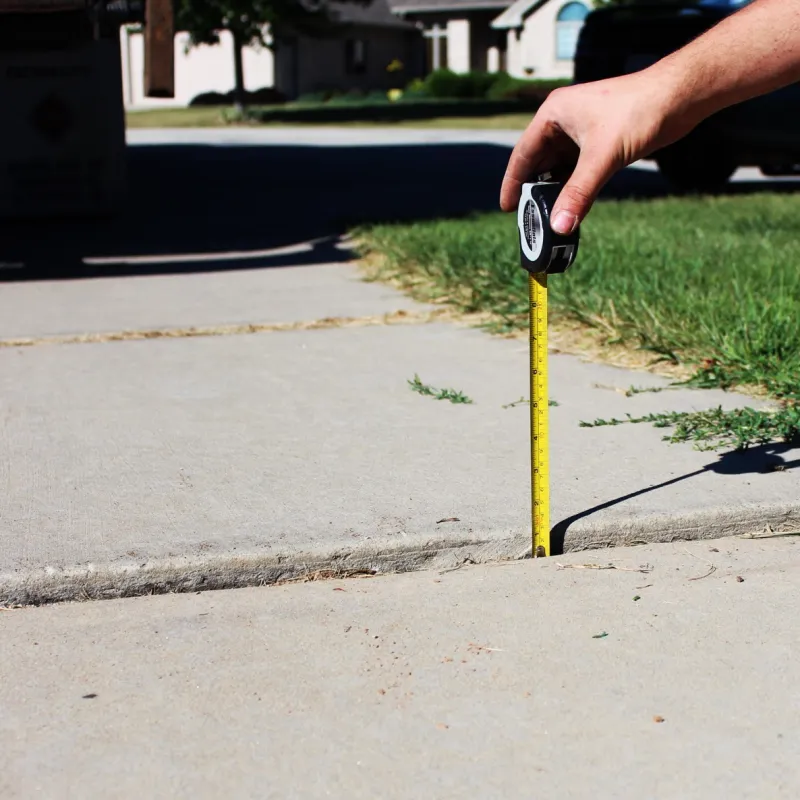
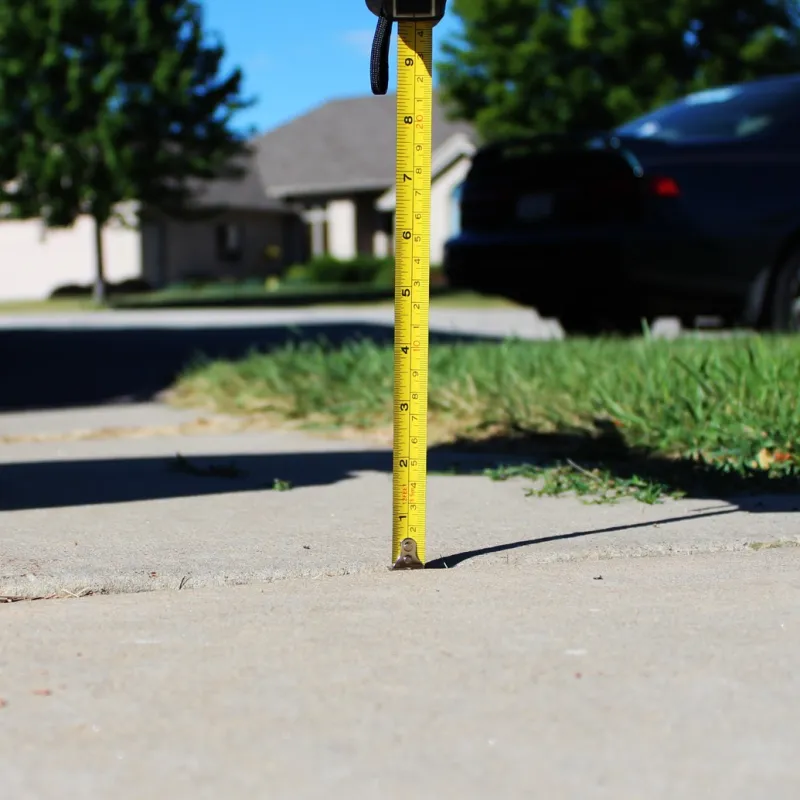
Example lifts. Photos from our own local jobs get added as we finish them.
A Quick Self-Check Before You Call Anyone
- 1Lay a straightedge across each joint. One slab lower than its neighbor? Lift first.
- 2Step on every corner and tap with a hammer handle. Rocking or a hollow sound means a void.
- 3Look at the cracks. One side higher, or wider than last year? The slab is still moving.
- 4Hose it down. Water running toward the house or ponding is a pitch problem an overlay won't fix.
- 5Measure your clearances at the door threshold, the bottom step, and the siding.
- 6Is the damage only on top? If the slab passes the first five checks, it's an overlay candidate, or maybe just a cleaning and sealing one.
Who Does What
We don't pour overlays, resurface, or replace concrete. A concrete contractor handles concrete resurfacing, toppings, and replacement. A flooring installer handles self-leveling underlayment under new indoor flooring. We handle lifting, joint and crack caulking, concrete cleaning, penetrating sealers for outdoor concrete, and garage floor coatings.
Two honest notes:
- If the slab is sound and just looks worn, start with cleaning. Grime, mildew, and stains make concrete look older than it is. On a sound outdoor slab that's starting to wear, a penetrating sealer helps keep water and salt out. It won't rebuild a surface that has already flaked, but it can slow down more flaking. More in why seal concrete.
- If you plan to resurface after a lift, tell us before we caulk. Some resurfacer makers say not to apply their product over flexible crack fillers, and the joints need to be carried up through the overlay anyway. Sealing the joints after the overlay cures usually makes more sense.