
In this article (9 sections)
It's a fair question to ask before you pay anyone to lift concrete. You're not buying a new slab. You're paying to put an old one back where it was. Will it stay there?
Anyone who quotes you an exact number of years is guessing. What we can tell you is what decides it, because most of it is visible from your driveway, and much of it is in your control.
What a Lift Fixes, and What It Leaves Alone
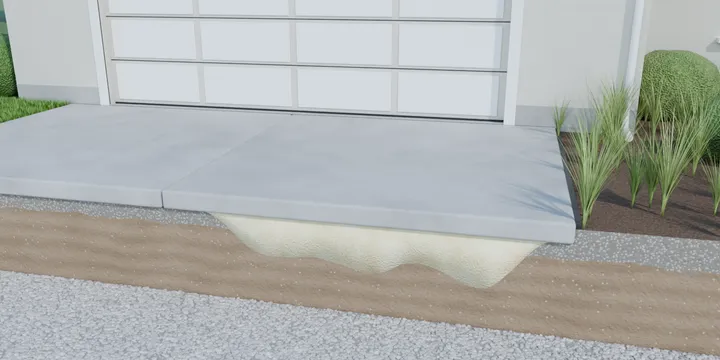
A foam concrete lifting job does two things: it fills the empty space under a slab, and it raises the slab back to where it belongs. Foam goes in through 5/8" holes, about the size of a dime, fills voids first, then lifts the slab in small, controlled increments.
What it doesn't touch:
- The water. A downspout, sump line, or bad grade that sank the slab once will keep working on the ground around it.
- The soil below the foam. If that soil keeps compressing or washing away, the slab and foam can drop together.
- Frost. Wet clay under a slab still freezes and heaves. A layer of foam doesn't stop that.
- Roots. A growing root keeps pushing. A rotting one keeps leaving holes.
- The concrete itself. Cracks, flaking, and worn edges stay what they were.
So the real question isn't how long the foam lasts. It's how long the ground under your slab stays put.
What Shortens a Lift and What Extends It
| Factor | Shortens the life of a lift | Extends it |
|---|---|---|
| Water source | Downspout or sump still dumping at the slab; yard sloping toward it | Water carried 6–10 feet away onto ground that slopes off |
| Joints and the gap at the house | Open joints that funnel runoff underneath | Joints sealed with flexible sealant over backer rod |
| Why it sank | Ongoing erosion from a source nobody fixed | One-time settling of backfill that has mostly finished |
| How far it dropped | A big drop over a deep washout | A modest drop over a small void |
| Soil | Soft, wet clay or loose, fresh backfill | Firm, well-drained soil |
| Age of the house | New construction, backfill still settling | Older home where the ground has had years to settle |
| Traffic and loads | Heavy trucks, dumpsters, trailers on slab edges | Cars and foot traffic, loads kept off edges |
| Trees | A growing tree nearby, or a recently removed one with roots rotting | No big trees within root reach |
| Frost exposure | A wet, shaded spot that stays soggy into spring | A spot that drains and dries quickly |
| Slab condition | Cracked into several pieces | One piece, or one crack |
| Edges | Soil washed away from the sides, foam left exposed | Edges backfilled and grassed |
| Workmanship | Hollows left unfilled, or one spot forced up fast | Voids filled first, slab raised in small, checked increments |
Read down the right column and you'll notice most of it is drainage. That's not a coincidence.
The Big Five, Up Close
Water: whether the cause got fixed
This one outweighs everything else. Concrete in northeast Wisconsin almost always sinks because water carried soil away or softened it: downspouts, sump discharge, snowmelt soaking loose backfill. Lift the slab and leave the downspout dumping at its corner, and next April's melt starts digging a new void beside the foam.
Fix the water and you've removed the reason the slab moved in the first place. It's also the cheapest part of the job, and usually something you can do yourself; see how to extend downspouts.
Void size and why it sank
A slab that dropped 1/2" because the backfill along the house finished compacting is a different animal from one that dropped 3" over a washout. The first one sank once, for a reason that's mostly done. The second one is telling you water has a highway under there.
Big voids are fillable. Foam follows open space and fills it as it lifts. But a big void is a sign to look harder at the cause before and after the lift. Our voids guide covers what creates them.
Soil: clay, sand, and fresh backfill
Much of the Green Bay area sits on red, clay-rich glacial till and old lake clays. Clays and silts are the most frost-susceptible soils there are: they hold water, drain slowly, and heave when they freeze. Sandy, gravelly ground drains faster and moves less.
Then there's the strip along your foundation, backfilled after the basement went in. On a newer house, that soil may keep settling for years, so the ground around a lift there may keep adjusting.
Traffic and heavy loads
Cars on a driveway are what it was built for. The trouble is the occasional heavy load on an edge: a roll-off dumpster, a loaded trailer, a concrete or delivery truck backing up onto the apron. Edges and corners have the least soil support, so that's where heavy loads do the most harm.
Roots, growing or rotting
A growing tree can push neighboring slabs up after a lift, which isn't the lift failing but can still look like it. A tree that came down in the last few years is the opposite problem: its roots rot in place and leave tunnels, and slabs nearby can start sinking. If there's a stump within root reach of your slab, expect that area to keep changing. Our tree roots article covers both sides.
3D render, not a job video. It's a generic example, a driveway slab that sank at the garage door; the steps are the same on any slab. The ground is cut away so you can see under the slab; nothing is dug on a real job. Simplified to four ports; a real 10 by 10 foot section usually gets six to ten. The foam's weight, strength and set time, with sources, are in how foam lifting works.
Transcript: what the video shows (23 seconds, no sound)
- 1. Set the line. A laser line off the slab that didn't move shows how far the low one has to come up. This one sank about 2″, a little more at the corner.On screen: About 2″ low; Laser line = target; Empty space under the slab.
- 2. Drill and set the ports. 5/8″ holes, kept in from the edges, then a plastic injection port tapped into each one so the gun can lock on.On screen: Injection ports.
- 3. Pump the foam. Two liquids travel down separate hoses and mix in the gun. They go in through the first port and run to the lowest spots.On screen: Liquid runs to the low spots.
- 4. Expand and fill. Within seconds the mix expands 15 to 22 times its liquid volume and fills most of the space from that port. The next port fills the rest, pressing loose soil tight.On screen: Expands from the first port; Second port fills the rest.
- 5. Lift to the line. Once the space is full, short shots, port to port, raise the slab evenly. We stop when it meets the line.On screen: Short shots, port to port; Back on the line.
- 6. Patch and caulk. The ports come out, each hole is packed with grout and troweled flush, and the joint at the garage gets a bead of flexible sealant.On screen: Garage joint caulked.
Foam vs. Mudjacking: Which Holds Longer?
Both methods fill the space under a slab and raise it. The differences that affect lifespan come down to weight and water.
| Polyurethane foam | Mudjacking | |
|---|---|---|
| Weight of the fill | A few pounds per cubic foot | Around 100 pounds per cubic foot |
| Water | Closed-cell and waterproof once cured; won't wash out | Cement-based slurry can erode if water keeps reaching it |
| What can shorten it | Water moving the soil around and below it; foam left exposed to sunlight at an edge | The same soil and water problems, plus heavy fill on soft ground |
| What cost guides say | Lasts longer than mudjacking, no agreed number | Commonly 5–10 years when done well |
Two honest notes. First, lifting foam data sheets list shrinkage as none or negligible, but sunlight does break down any foam left exposed where it squeezed out at an edge, which is why exposed foam should be trimmed and covered with soil. Second, on dry, stable ground with no water problem, mudjacking can hold up well too. The method matters less than whether anyone fixed the reason the slab sank. For the full comparison, see foam vs. mudjacking.
Three Slabs on the Same Street
Here's a made-up example, but it's how this usually plays out. Three neighbors each get one slab lifted the same week, by the same crew, with the same foam.
- Neighbor A lifts a patio that tipped toward the house. The same weekend, they extend the downspout 10 feet, have the gap at the wall sealed, and fill the trench of settled soil along the foundation. Years later, the patio still sheds water away from the house.
- Neighbor B lifts a garage apron but leaves the downspout dumping at its corner and the joint at the garage floor open. Two springs later, that corner has dropped again. The foam didn't go anywhere. The soil beside it did.
- Neighbor C lifts two front walk panels next to a big maple. The lifted panels stay put, but a third panel closer to the tree keeps creeping up. The lift held. The tree kept growing.
Same lift, three outcomes. The difference was everything around the slab.
When a Slab Needs a Second Lift
If a lifted slab settles again, it can usually be lifted again. A re-lift works much like the first one: new 5/8" holes are drilled, and foam goes into the existing foam layer and any new space that has opened beneath it. Since much of the original void is already filled, a touch-up is often a smaller job than the first lift.
Before anyone re-lifts, find out why it moved. If the downspout is still dumping there, a second lift buys time, not a fix.
A re-lift isn't the answer when:
- There's an active leak from a buried pipe or drain line under the slab. A plumber fixes that first.
- Roots pushed something up. Foam can't lower a heaved slab. If it's frost, wait for the thaw, then it's fine to send in: we look at lifting the slabs around it to meet it. See frost heave vs. settling.
- The slab has broken into several pieces. That's a replacement conversation.
A slab mudjacked years ago can usually be foam lifted too, through new, smaller holes. We don't mudjack ourselves; foam is our alternative to mudjacking.
How to Make a Lift Last
Most of this is cheap, and most of it you can do yourself.
- Move the downspouts. Get roof water at least 6 feet from the foundation (10 is better), past the edge of the slab, onto ground that slopes away. Check each spring that the extensions are still attached; mowers and snowblowers knock them loose.
- Fix the grade. For new homes, the model building code calls for the ground to fall at least 6 inches within the first 10 feet of the foundation. Fill the settled trench along the wall with compacted soil, not just mulch, so water runs off instead of down. Our soil grading guide has the details.
- Seal the joints and the gap at the house. A flexible polyurethane sealant over closed-cell backer rod keeps runoff from pouring under the slab. It goes in on a dry, frost-free day at 40°F or warmer, ideally right after the lift and patching. Check it every spring and reseal any splits. See caulking where concrete meets the house.
- Seal the surface. A penetrating silane or siloxane sealer helps outdoor concrete shed water and resist salt damage, and typically lasts around 5–10 years. Reseal when water stops beading. It protects the slab more than the soil under it, so think of it as protecting the concrete you just saved. Joint sealant goes in, and cures, before the sealer. See why seal concrete.
- Don't pile salt or snow on lifted slabs. A snowbank plowed onto the walk beside the house melts slowly into the joints and edges for weeks. Don't store bags of deicer on the concrete, go easy on salt, and skip ammonium nitrate and ammonium sulfate entirely. Calcium and magnesium chloride can react with concrete to form a compound that expands and causes damage even above freezing.
- Keep the edges covered. Backfill any washed-out slab edge with soil and get grass growing, and fill burrow holes once the chipmunks are gone. If foam shows at an edge, trim it and cover it.
- Keep heavy loads off the edges. A dumpster goes on the street or on plywood, not on the apron corner.
The 5-Minute Yearly Check
Do this once a year in late May or June, after the frost is fully out. WisDOT's spring thaw limits run on average from about March 9 to May 9, so anything you measure earlier can still be frost talking. A quick look in early fall, before freeze-up, is a bonus.
- 1Photo (1 minute)Stand where you took the "after" photo and take it again. Compare them side by side.
- 2Straightedge (1 minute)Lay a straight board across each lifted joint. Any new lip?
- 3Level (1 minute)On slabs next to the house, set a 4-foot level pointing away from the wall. You want about 1" or more of drop under the outer end, which is roughly 2 percent.
- 4Caulk lines (1 minute)Walk the joints and the gap at the house. Look for splits, pulled-away edges, or weeds.
- 5Water and edges (1 minute)Downspout extensions attached and pointing away? Soil still packed along the slab edges? No new animal holes?
If everything matches last year, you're done. If a lip has come back, the slope has flattened, or a joint has opened, take a photo with a tape measure in it and figure out what changed before next spring's melt.
Ask About Any Warranty Before You Hire
If a contractor offers a written warranty, read it before you sign. Ask how long it runs, whether it covers a re-lift, whether it transfers if you sell, and what conditions come with it, such as keeping downspouts extended and joints sealed. Our guide on how to choose a concrete contractor has more questions worth asking.
Ours runs 5 years: if a slab we lifted settles again, we come back and re-lift it at no charge, as long as the joints stay sealed and the downspouts drain away from the concrete. The full terms are on our warranty page.